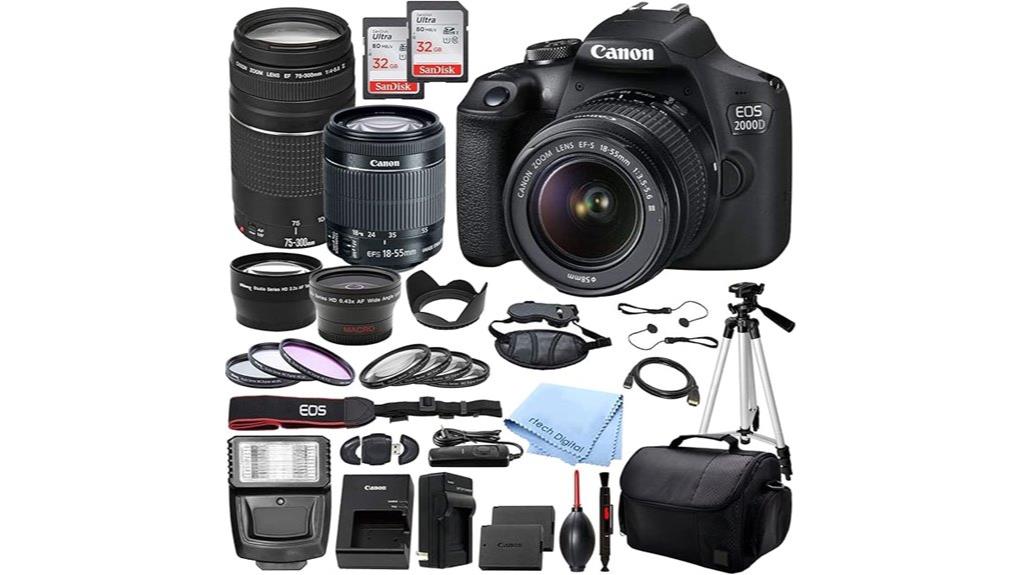
The Canon EOS 2000D (Rebel T7) is a straightforward, budget DSLR that’ll teach you fundamentals with a 24MP APS‑C sensor, simple menus, and guided modes. You’ll get decent stills and usable 1080p video, though noise rises past ISO 1600 and stabilization is lacking. Kit lenses (18–55mm and 75–300mm) cover most starts but limit low‑light and edge sharpness. It’s ideal for beginners or a cheap backup; keep going to see specifics, pros, cons, and alternatives.
Some Key Takeaways
- 24.1MP APS‑C sensor delivers clean, detailed images suitable for prints and web use for beginners.
- Simple, intuitive layout with guided modes makes it ideal for photography learners.
- Kit lenses (18–55mm, 75–300mm) cover wide-to-telephoto needs but have limited low-light and edge performance.
- 1080p video and basic autofocus are serviceable for vlogs and casual clips but lack advanced stabilization and tracking.
- Good battery life and affordable pricing make it a strong starter option; advanced users may quickly outgrow it.
What the Canon EOS 2000D (Rebel T7) Actually Is and Who It’s For
Think of the Canon EOS 2000D (Rebel T7) as a straightforward, entry-level DSLR built to get beginners shooting better photos without a steep learning curve. You’ll find its entry level appeal in a simple layout, reliable image quality, and dual-lens bundle that covers wide to telephoto needs. It’s aimed at new photographers who want hands-on control while learning fundamentals; the camera supports beginner education with guided modes and intuitive menus. You’ll appreciate durable build and affordable price, though advanced users may outgrow its limitations. For learning composition and exposure, it’s a practical, cost-effective classroom on the go. It pairs well with essential DSLR accessories like camera straps to complete a beginner’s kit.
Key Specs at a Glance: Sensor, Autofocus, Display, Video, and Zoom
While it’s aimed at beginners, the EOS 2000D (Rebel T7) packs a sensible set of core specs: a 24.1‑megapixel APS‑C sensor delivers detailed stills, a 3.0‑inch display gives you clear playback and menu navigation, and Full HD 1080p video covers basic movie needs. You’ll get a straightforward DC micro motor autofocus in the kit lenses, a usable 3× optical zoom range, and predictable menu layout that’s easy to learn. Battery life is decent for casual shoots, build quality feels lightweight but durable, and accessory compatibility with EF/EF‑S glass and flashes keeps the system flexible. It’s a great match for enthusiasts shopping for mirrorless camera accessories and compatible gear.
Real-World Performance: Image Quality, Low‑Light, Autofocus, and 1080p Video
Although aimed at beginners, the EOS 2000D delivers image quality that will satisfy most casual shooters. You get clean, detailed 24MP files with reasonable dynamic range for prints and web use. In low light you’ll rely on higher ISOs; noise becomes noticeable past ISO 1600, but images remain usable with cautious exposure and noise reduction. Autofocus using the DC micro motor is generally accurate for stills, though subject tracking isn’t elite and occasional shutter lag appears in some modes. 1080p video is sharp and serviceable for vlogging or home clips, but lacks advanced stabilization and cinematic depth. For better exposure control and consistent results, pairing the camera with an external light meter can help fine-tune settings in challenging lighting.
How the Included 18–55mm and 75–300mm Lenses Affect Results and Shooting Uses
Beyond sensor and body performance, the two bundled lenses shape what you’ll actually shoot and how your images look. The 18–55mm gives landscape versatility and everyday framing; it’s compact, handles wide scenes well, and works for environmental portraits though edge sharpness and aperture limits restrict dramatic separation. The 75–300mm supplies portrait reach and long-distance framing for sports or wildlife, but its variable f/4–5.6 aperture and basic coatings mean slower AF in low light and softer corners at telephoto extremes. Together they cover most beginner needs, letting you explore genres before investing in faster, higher-quality primes or zooms. Using appropriate lens filters can further improve contrast and protect your front element while shooting in varied conditions.
Should You Buy It? Pricing, Alternatives, and Who Should Choose Refurbished Units
If you’re shopping on a tight budget, the renewed Canon EOS 2000D (Rebel T7) kit with the 18–55mm and 75–300mm lenses delivers a lot of practical capability for the money—24MP stills, 1080p video, and broad focal-range coverage—though you’ll trade off low-light performance, autofocus speed, and build quality compared with newer or higher-tier bodies. You should buy it if you want a reliable starter DSLR, long battery life for day trips, and an inexpensive way to learn composition and manual controls. Consider newer used bodies or mirrorless options for better AF and future resale value. Refurb units suit first-time buyers. Gear Guide offers a wide selection of refurbished and new camera products to help enthusiasts find the right gear for their needs, including detailed comparisons of DSLRs and mirrorless systems with product recommendations.
Some Questions Answered
Does the Camera Include a Memory Card and Battery in Renewed Units?
No — battery included? Usually renewed units include a rechargeable LP-E10 battery, but sellers vary; always confirm. Memory excluded? Most renewed kits don’t include a memory card, though some sellers bundle a 32 GB card. You should check the specific listing and seller notes, look for “battery included” or “memory included” labels, and message the seller if unclear. That guarantees you won’t be surprised when the package arrives.
Is Wireless (Wi‑Fi) Remote Control Supported for Shutter Release?
No, the camera doesn’t natively support a wireless (Wi‑Fi) remote shutter release via an external remote; you’ll use the built‑in Wi‑Fi for remote app control through Canon’s Camera Connect app instead. That app lets you trigger the shutter and do basic interval shooting, but it’s not a full wireless intervalometer. If you need advanced interval timing or wireless triggering, you’ll want a dedicated third‑party wireless intervalometer or wired remote.
What File Formats (Raw/Cr2/Jpeg) and Max RAW Bit Depth Are Available?
You get RAW support and JPEG files — the camera records Canon’s CR2 RAW plus standard JPEGs. You’ll be shooting 14‑bit RAW images (CR2), which preserves wide tonal range and better post‑processing flexibility. JPEGs are available in various quality and size settings for immediate use. This combination gives you full RAW editing latitude or convenient JPEGs straight from the camera, depending on your workflow and storage preferences.
Are Firmware Updates Applicable to Renewed/Older Rebel T7 Bodies?
Yes — you can install Canon firmware on renewed or older Rebel T7 bodies, but you should check serial specific support before updating. You’ll evaluate current firmware, release notes and compatibility; if the body’s serial is supported you can update, though firmware rollback isn’t officially supported and may be risky. Keep backups, follow Canon’s instructions, and contact Canon support if the serial number isn’t listed or if you hit issues during update.
Can the Camera Charge via USB or Only Through an External Charger?
No, the camera won’t charge via USB; you’ll need the external LP-E10 charger to recharge batteries. You can power the camera from USB only with third-party power adapters and dummy battery rigs, but those don’t recharge the LP-E10 internally. That limitation can affect Battery lifespan if you frequently use makeshift USB powering, since irregular charging methods and third-party solutions may degrade battery health faster than proper charging with the recommended charger.