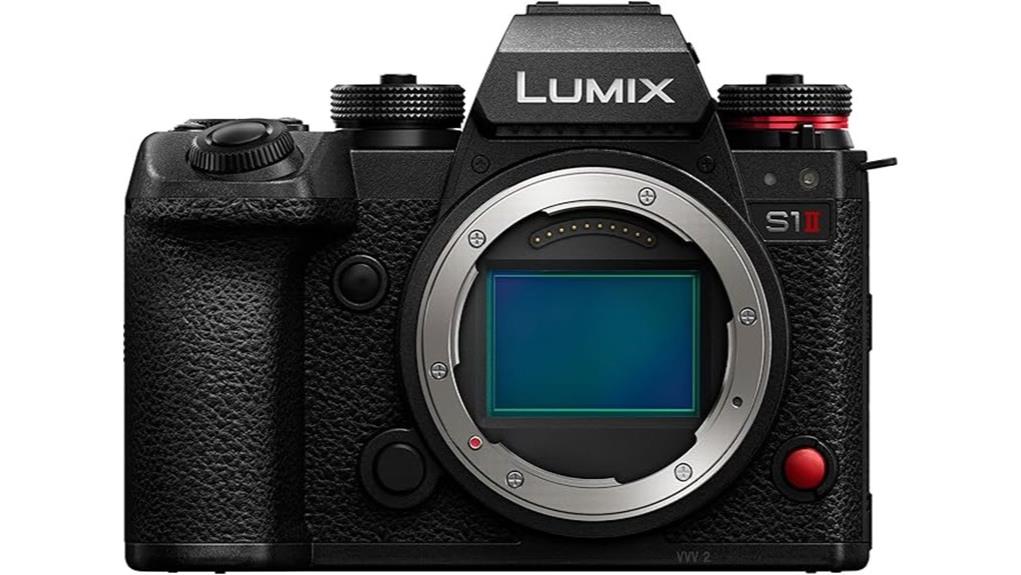
You’ll get a pro-grade hybrid that prioritizes 6K video while keeping stills performance strong: the 24.1MP partially stacked full‑frame sensor balances resolution, speed, and low noise, and Panasonic’s natural color rendering preserves skin tones. You’ll shoot 6K/5.1K open‑gate, 4K120p, and ProRes RAW HQ for flexible grading, plus handheld 96MP high‑res mode and 70 fps AF‑C for action. Ergonomics, IBIS, and pro workflows are solid — read on for full technical tradeoffs and workflow tips.
Some Key Takeaways
- Delivers professional 6K open‑gate 30p and 5.1K 60p capture with ProRes RAW support for high-detail, grade-friendly video workflows.
- 24.1MP partially stacked full‑frame sensor balances low noise, fast readout, and excellent dynamic range for both video and stills.
- Robust IBIS (up to ~8 stops with stabilized lenses) and blackout‑free EVF enable stable handheld video and uninterrupted framing during bursts.
- Stills features include a handheld 96MP‑equivalent high‑res mode and 70 fps AFC for action and high‑detail capture.
- Practical for travel and indie filmmakers, but open‑gate heat, large files, and recommended external monitor should be considered.
Verdict and Who Should Choose the Panasonic LUMIX S1II
Although it’s built on a familiar S-series foundation, the LUMIX S1II shifts the balance toward hybrid creators who demand top-tier video without sacrificing stills performance. You’ll find pro video tools—6K/5.1K open-gate, ProRes RAW, C4K/4K 120p—paired with handheld high-res mode and fast AFC, so you won’t compromise on either medium. Compared with cinema-centric bodies, it’s more adaptable and, despite its features, serves budget conscious filmmakers seeking value per feature. If you travel, this travel friendly hybrid offers robust IBIS, blackout-free viewfinder, and streamlined workflows, making it practical for mixed commercial and documentary shoots. For photographers and videographers who use external displays, pairing the S1II with an external camera monitor can significantly improve on-set framing and focus accuracy.
Image Quality: 24MP Sensor, Color Science, and Dynamic Range Boost
When you push the LUMIX S1II’s 24.1MP partially stacked full‑frame sensor, it delivers a balance of resolution, speed, and low‑noise performance that favors both video and stills workflows. You’ll notice Panasonic’s Color Rendition leans natural, with restrained saturation and accurate skin tones compared with warmer rivals. Sensor Dynamics provide low‑light headroom and rapid readout, reducing rolling shutter while preserving midtone detail. Dynamic Range Boost smooths gradients and recovers highlight detail, useful for high-contrast scenes. HEIF support and refined demosaic yield cleaner files at base ISO. Overall, image quality trades peak megapixels for practical fidelity and adaptable workflow results. For photographers prioritizing consistent color in post, pairing the camera with color checker cards can streamline profiling and ensure accurate results.
Video Features: 6K/5.1K Open Gate, 4K 120p, and ProRes RAW HQ
Building on the sensor’s low‑noise readout and Dynamic Range Boost, the S1II stakes a strong claim in hybrid video with a combination of high‑resolution capture and high‑frame-rate options. You get 6K open gate 30p and 5.1K 60p open gate, which extend framing flexibility and improve downsampled 4K detail; open gate implications include wider aspect control but larger file and heat considerations. C4K/4K 120p suits slow‑motion needs. ProRes RAW HQ and internal Cinema codecs simplify Raw workflows and color grading, while diverse frame rates let you match broadcast or cinematic deliverables with precision. Consider pairing the S1II with a field monitor to better evaluate exposure and framing on location.
Still Performance: 96MP High-Res, 70 Fps AF-C, and Low-Noise Results
Because Panasonic combined a partially stacked 24.1MP sensor with advanced processing, you’ll get both high-speed capture and an impressively clean baseline for stills. You can produce 96MP-equivalent handheld highres files with minimal ghosting; comparisons show finer microdetail than typical multi-shot modes on slower-readout bodies. AFC at 70 fps sustains tracking of rapid subjects, and sports tracking benefits from the sensor’s readout and buffer management. Noise remains low across ISO range thanks to efficient downstream processing, yielding usable shadows and midtones where competitors thin detail. Overall, the S1II balances resolution, speed, and low-noise performance for demanding stills work. The site also offers a wide selection of accessories for mirrorless systems, including lenses and support gear for serious enthusiasts camera fans.
Workflow, Stabilization, Autofocus, and Real-World Ergonomics for Pros
While the S1II packs pro-level features, its real-world workflow and handling make them practical for daily production work — you’ll find the menu logic, physical controls, and connectivity geared toward shortening setup and handoff times. You’ll appreciate robust battery life for long shoots and reliable IBIS that pairs with stabilized lenses to deliver up to 8 stops of correction, outperforming many rivals. Autofocus is fast and consistent—AI face detection handles tilted or obscured faces—while blackout-free EVF helps composition during bursts. Menu ergonomics and physical dials streamline adjustments; integration with Capture One, Flow, and Frame.io speeds post, matching pro pipelines. Our store carries a curated selection of mirrorless camera accessories to help you get the most from systems like the S1II.
Some Questions Answered
What Are the Battery Life and Real-World CIPA Ratings?
You’ll get solid battery endurance: expect around 340–360 shots per charge in mixed use, and roughly 95–120 minutes of continuous video recording, depending on settings. CIPA performance sits near those stills numbers in practical testing; real-world CIPA performance often ranges 330–370 shots when using IBIS and occasional bursts. Comparatively, that’s competitive with full-frame rivals, though heavy video or high-rate bursts will reduce endurance noticeably.
Which Lenses Are Recommended for Full 6K Open-Gate Use?
Use full-frame fast primes and cine zooms with consistent sharpness across the frame for true 6K open-gate. You’ll prefer fast primes (50mm, 35mm, 24mm) for ultimate resolution and low-light headroom, while cine zooms (24–70mm, 70–200mm) give parfocal performance and smooth breathing control. Compare sharpness, vignetting and corners at open-gate; prioritize lenses that resolve beyond 24MP to exploit the sensor’s 6K detail.
Does It Support Dual Memory Card Recording Formats?
Yes — you get dual slot capability supporting simultaneous recording formats. You can set the second card for backup, overflow or separate RAW/HEIF and video files, which aids a strict backup strategy and simplifies file management. Objectively, dual slot offers redundancy like higher-end cinema bodies and flexibility versus single-slot cameras. Comparatively, it streamlines workflows for mixed stills/video shoots and reduces post-shoot risk of data loss.
How Weather-Sealed Is the Body for Extreme Conditions?
You’ll find the body very robust for extreme conditions. It uses a magnesium alloy chassis with extensive weather sealing and high-grade gasket quality around seams, buttons and dials, and secure port covers that resist dust and moisture. Compared to consumer-grade models it’s markedly tougher, matching pro-tier construction, though true submersion needs dedicated housings. You’ll still want caution in prolonged exposure to heavy salt spray or deep immersion.
What Firmware Updates Are Planned and How Often?
You’ll get a transparent firmware roadmap with a steady update cadence: Panasonic plans major feature releases several times yearly and smaller bug/security patches monthly or quarterly. Expect prioritized fixes for autofocus, stabilization, and codec support, plus comparative enhancements (e.g., ProRes RAW, HEIF tweaks) matched to competitor timelines. You’ll see release notes detailing changes, beta opportunities for pros, and coordinated updates aligning camera, LUMIX Lab, Capture One, and Frame.io integrations.