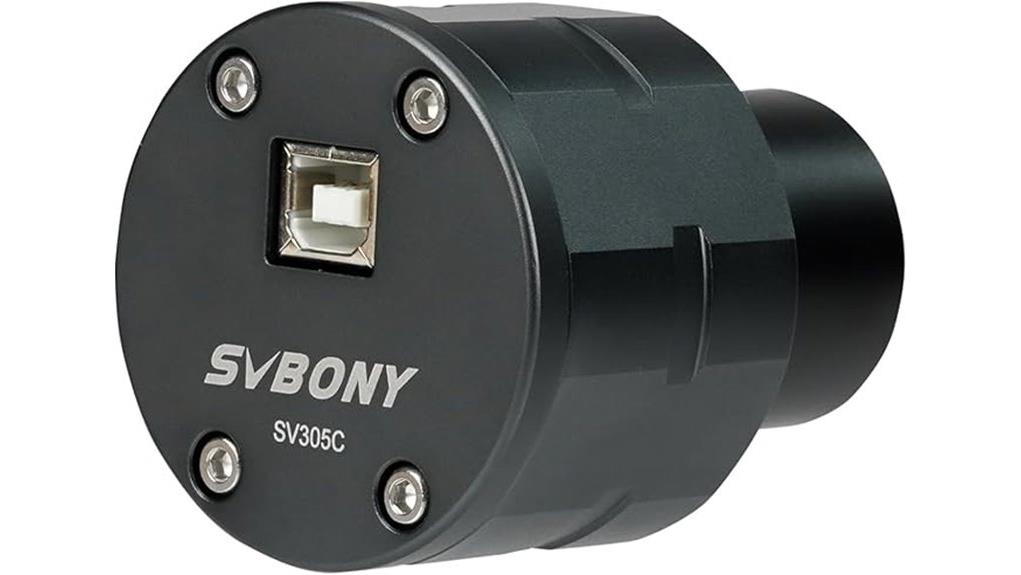
You’ll get a compact metal-bodied planetary/EAA camera using Sony’s back‑illuminated IMX662 (1/2.8″, 2.1MP) with 2.9 µm pixels, fixed UV/IR cut, CS/C adapters and 1.25″ eyepiece fit; it offers ROI, 2×2 binning, HCG noise reduction and a 128 MB buffer to prevent USB frame loss. It’s strong on lunar and high‑altitude planetary detail, practical for low‑latency EAA, and stable under good seeing—keep going to see setup tips, tradeoffs, and alternatives.
Some Key Takeaways
- Uses Sony IMX662 2.1 MP back‑illuminated CMOS sensor offering strong lunar/planetary detail and improved near‑IR/red sensitivity.
- Compact, sealed metal housing with removable front glass, CS mount, CS‑to‑C adapter, and 1.25″ eyepiece interface.
- 2.9 µm pixels, 38 ke full‑well, 2×2 binning and ROI support for flexible sampling and higher frame rates.
- 128 MB DDRIII buffer and HCG mode reduce frame loss and readout noise during high‑frame‑rate captures.
- Best for EAA and planetary imaging under moderate/good seeing; fixed UV/IR cut filter limits IR/narrowband flexibility.
How the SV305C Is Built: Sensor, Optics, and Physical Features
Because SVBONY built the SV305C around the Sony IMX662 back‑illuminated CMOS, you get a compact, efficient imaging core: the 1/2.8″ sensor delivers 2.1 MP at 2.9 µm pixels with a 38ke full‑well and improved near‑IR response, especially in the red band, while maintaining low readout noise and no glow. You’ll find compact construction and robust sealing in the metal body, a removable protective front glass, and a fixed UV/IR cut filter. The CS mount plus included adapter supports C‑mount optics and 1.25″ eyepiece interfaces. Internals house a 128 MB DDRIII buffer and heat‑managed layout for stability. For keeping the camera’s front elements and sensor area clean and safe, consider using sensor cleaning fluids designed for delicate optics.
Real-World Performance: Planetary, Lunar, and EAA Shooting Tests
When you push the SV305C into real-world use for planets, the Moon, and EAA sessions, its strengths and limits become immediately evident: the IMX662’s 2.9 µm pixels and improved red/NIR sensitivity deliver crisp lunar detail and strong contrast on high‑altitude planetary features, while the 128 MB DDRIII buffer and ROI/binning options keep capture streams smooth during high‑frame-rate planetary runs and long‑exposure stacks. You’ll find that moderate to good seeing conditions yield best results; poor seeing forces aggressive frame selection and lowers usable frames per capture cadence. EAA use is practical: low latency, stable histograms, and predictable focus behavior aid live stacking and documentation. The camera pairs well with 4k-capable drones and other high-resolution gear for those who enjoy aerial and terrestrial photography.
Speed, Sensitivity, and Noise: ROI, BIN, HCG, and Buffer Behavior Explained
Although the SV305C’s small 2.9 µm pixels deliver fine sampling, you’ll often trade resolution for throughput using ROI and 2×2 BIN to match target and seeing: reducing the ROI shrinks readout area and raises frame rates linearly with fewer pixels to transfer, while 2×2 binning effectively increases per-sample signal and sensitivity at the cost of halving spatial resolution. You’ll use HCG to lower readout noise at higher gains, improving faint-detail capture but slightly compressing dynamic range. The 128 MB DDRIII buffer caches frames during USB pauses, preventing frame lag and lost frames, keeping stacks clean during bursts. Many enthusiast astrophotographers also pair cameras with photo editing tablets to streamline post-processing and workflow.
Setup and Compatibility: Mounts, Filters, Software, and Telescope Fit
Getting the SV305C talking to your telescope and software is straightforward but benefits from a few precise choices up front. You’ll attach via the CS mount with the included CS-to-C adapter or the 1.25″ eyepiece interface; check mount threadings on accessories to guarantee secure coupling and correct parfocal distance. The built-in UV/IR cut filter is fixed, so assess filter compatibility when adding narrowband or IR-pass filters ahead of the camera; use external 1.25″ or C-mount filters accordingly. For software, use ASCOM-compatible capture tools (SharpCap, NINA) and confirm driver installation and exposure/ROI control for peak operation. Choose a protective drone carrying case that fits your camera and accessories to keep everything organized and safe.
Who Should Buy the SV305C and Alternative Options to Consider
If you’re an entry-level astrophotographer or EAA user seeking an affordable, compact color camera that balances planetary speed with reasonable deep-sky sensitivity, the SV305C is a strong fit. You’ll appreciate the IMX662’s 2.9 µm pixels, 38ke full-well, and low read noise for planetary runs and short EAA integrations. Beginner buyers benefit from ROI, 2×2 binning, HCG mode, and the 128 MB buffer that prevents frame loss during USB hiccups. If you need higher resolution or cooled long-exposure performance, consider budget alternatives like cooled CMOS cameras from ZWO ASI or QHY entry models. Consider pairing your camera with reliable external storage for backing up and organizing images on your photo library.
Some Questions Answered
Does the Camera Include a Built-In Fan for Cooling?
No, it doesn’t include a built-in fan for cooling; you get no active cooling, only passive cooling via the camera’s small metal body. You’ll want to take into account noise considerations in environments where electronic fans would matter, but this model avoids fan noise by design. The camera relies on thermal management through heat dissipation and buffering, so plan exposures and gain settings accordingly to minimize thermal noise and optimize image quality.
What Is the USB Cable Length and Connector Type Included?
The included USB A to USB C cable is two meter cable that connects the camera to your computer. You’ll get a standard USB-A plug for the host and a USB-C plug for the camera, supporting data transfer and power over a single lead. You’ll appreciate the 2 m length for flexible setup; the cable’s shielding and connectors are typical for astronomy cameras, minimizing interference and keeping connections secure during long capture sessions.
Is There Any Warranty or Customer Support Contact Information?
Yes — you’ll get warranty details and support contacts from the seller or manufacturer; they typically offer a limited warranty and email/website support. Check your purchase documentation or the product listing for exact warranty duration, coverage, and return procedure. If you need direct assistance, contact the vendor’s support email or submit a ticket through their support portal; keep your order number and serial to speed verification and claim processing.
Can the Camera Record Coincident Audio With Video Captures?
No — the camera records no audio with video captures. You’ll need an external microphone and separate recorder if you want sound capture; the device lacks built-in mic inputs or multiplexed audio channels. When combining files you’ll manually align audio and video in post to achieve proper audio sync. Use precise timecodes or clapper cues to simplify alignment, and keep recorder frame rates stable to avoid drift during longer EAA sessions.
Are There Firmware Updates and How Are They Installed?
Yes — firmware availability exists and SVBONY occasionally issues updates. You’ll check the manufacturer website or user forum for releases and read the changelog. Installation methods include vendor-provided Windows updater tools (run with camera connected via USB), or guided manual flash instructions using supplied firmware files and utilities. You’ll back up settings, follow step-by-step instructions, keep power/USB stable, and verify firmware version after the update completes to confirm success.