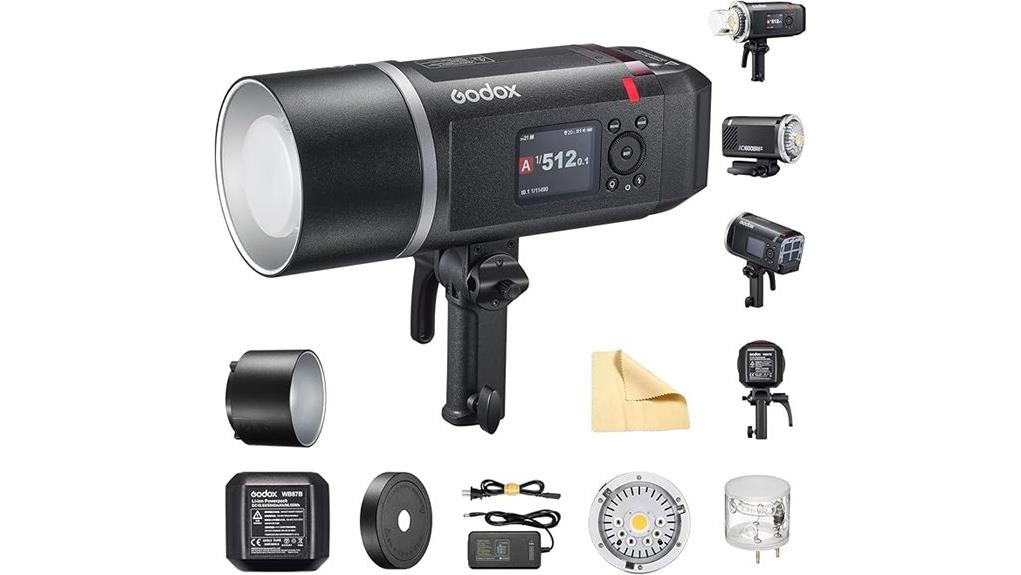
You’ll get a rugged 600Ws portable head with predictable output, 1/1–1/512 ten-step power, and 0.01–1.9 s recycle times for fast bursts. The 40W high‑CRI modeling LED is usable for framing and video. An 8,940 mAh pack gives roughly 500 full‑power pops and supports 1.5‑hour PD fast charging; an external AD‑AC adapter lets you bypass the battery. Built‑in 2.4G wireless and Bowens compatibility suit multi‑head workflows—keep going to see more detailed comparisons and caveats.
Some Key Takeaways
- 600Ws portable monolight with 1/1–1/512 ten-step power range for consistent, repeatable exposures.
- Fast 0.01–1.9s recycle times support responsive burst shooting and multi-shot sequences.
- Built-in 40W high-CRI modeling LED provides usable continuous light for framing and video.
- 8,940 mAh battery yields roughly 500 full-power flashes and supports 1.5-hour PD fast charging.
- 2.4G Wireless X system, 2.8″ color display, and Bowens mount enable streamlined multi-head workflows and modifier compatibility.
Real-World Performance: Flash Power, Recycle, and LED Modeling
When you push the AD600BMII to work, its 600Ws output and 1/1–1/512 ten-step power range deliver consistent exposure control, while the 0.01–1.9 s recycle times keep burst shooting responsive for most run-and-gun scenarios. You’ll rely on precise flash consistency across power settings, with predictable falloff and repeatable output for multi-shot sequences. The 40W high-CRI modeling LED gives usable continuous illumination for framing and video, maintaining color stability under varied settings. Controls and display let you adjust power and monitor output quickly. You can pair additional H600P heads for multi-angle setups without compromising consistency. Perfect lighting starts with the right continuous setup, and using LED photo lights can help you achieve more reliable results.
Battery Life and Charging Options: How Many Pops, Fast Charge, and Continuous Use
Frequently, the AD600BMII’s 8,940 mAh lithium pack gives you up to roughly 500 full-power flashes per charge, delivering reliable throughput for location shoots and extended sessions. You’ll see 1.5-hour PD fast-charge times with the included 3-in-1 charger, letting you return to shooting quickly. Charging ergonomics are sensible: compact charger, clear battery indicators, and a 2.8-inch display showing progress. For continuous use you can attach an external AD-AC adapter (sold separately) to bypass the battery. Monitor long term degradation—battery capacity will decline with cycles—so budget replacements after heavy professional use to maintain peak performance. Consider pairing the AD600BMII with an external storage solution to safeguard your photo library and workflow, such as a portable external hard drive for backing up files on location.
Controls, Wireless Range, and Multi-Unit Workflow With Godox Triggers
Although compact, the AD600BMII’s controls give you direct, efficient command over multi-unit setups: a clear 2.8-inch color display and logical knob/button layout let you change power, group, and channel settings quickly, while one-button group sync ties multiple heads together for instant grouping. You’ll use the built-in 2.4G Wireless X System with Godox triggers (Xpro II, X2T, X1, X3) to assign channels and perform channel mapping across 16 color-coded groups. Group latency is minimal in my tests, maintaining sync for high-speed shooting. The interface and triggers let you manage multi-unit workflows reliably and predictably. The AD600BMII pairs seamlessly with Godox wireless triggers to streamline studio and on-location setups.
Build, Mount Compatibility, and Accessory Ecosystem (Bowens, H600P, Modifiers)
If you need a durable, modular strobe for varied shooting contexts, the AD600BMII delivers a rugged yet portable build with a standard Bowens mount that lets you attach a wide range of modifiers without adapters. You’ll appreciate the metal-reinforced mounting points, heat-managed housing, and balanced weight for handheld or stand use. The Bowens ecosystem gives you instant access to softboxes, snoots, grids, and parabolic reflectors; Accessory compatibility extends to speedrings and magnetic adapters from third parties. If you add the H600P head (sold separately) you’ll enable multi-angle setups while maintaining consistent mounting and control protocols. For macro photographers, pairing this strobe with dedicated macro lenses and close-up modifiers can significantly improve lighting control and subject detail.
Who Should Buy It and How It Compares to the AD600 and Competitors
Having covered build and accessory compatibility, let’s look at who benefits most from the AD600BMII and how it stacks up against the original AD600 and rival 600Ws units. You’re a prospective buyer if you need a 600Ws portable head with fast recycle (0.01–1.9s), long battery life (≈500 full-power flashes), and integrated 40W LED for hybrid shoots. Compared with the AD600, the BMII adds updated electronics, PD fast charging, and refined controls. Competitive positioning versus other 600Ws models hinges on battery capacity, wireless integration, and Bowens ecosystem support—tradeoffs include weight and price versus studio-tethered alternatives. The AD600BMII also pairs well with float grips for safer handling in on-location work when shooting near water or on boats, thanks to its robust portability and accessory compatibility with Float Grips.
Some Questions Answered
Does It Support TTL or HSS Modes?
Yes — you’ll get TTL compatibility and High speed sync support. You can use TTL with compatible Godox triggers (Xpro II, X2T, X1, X3) for automatic exposure, and enable High speed sync for shutter speeds above camera sync speed. You’ll control modes and groups via the 2.4G Wireless X System, the 2.8-inch display, or on-trigger settings. This supports fast-paced shooting workflows requiring automated exposure and HSS.
Is It Weather-Sealed or Splash-Resistant?
No, it isn’t fully weather-sealed or rated as splash-resistant. You shouldn’t rely on it for wet or dusty environments without protection. The unit lacks formal ingress protection, so weather resistance is limited and you risk dust ingress and moisture damage during exposure. Use protective covers, rain sleeves, or operate under shelter to prevent failures. For harsh conditions, choose gear with explicit IP ratings or purpose-built weatherproofing.
Can the Battery Be Swapped Mid-Shoot Without Powering Down?
No — you can’t hot swap the battery mid-shoot without powering down. The unit requires battery removal and replacement, so true hot swappable battery operation isn’t supported. For continuous power during shoots you’ll need the optional AD-AC power adapter or use a second charged battery and power-cycle between them. Plan shoots accordingly to avoid interruptions, and use the PD fast-charging charger to minimize downtime between battery swaps.
Does It Include Built-In Fan Cooling for Long Runs?
Yes — it has built in fannoise management for active cooling. You’ll get an internal fan that engages under heavy use to maintain cooling efficiency, reducing thermal cutouts during extended flash or LED runs. The fan speed modulates based on temperature and duty cycle, so noise and airflow scale with load. You can expect reliable thermal control for continuous shooting, though very long high-power bursts will still trigger protection.
Are Firmware Updates User-Installable via USB or OTA?
Yes — you can install firmware yourself. For firmware installation, Godox supports USB-based update methods via a dedicated port and updater software; OTA updates aren’t provided for this model. You’ll download firmware files, connect the unit to your computer, and run the updater to apply the update. Follow precise instructions and make certain battery/AC power during the process to avoid corruption. Firmware installation requires the manufacturer’s official utilities.