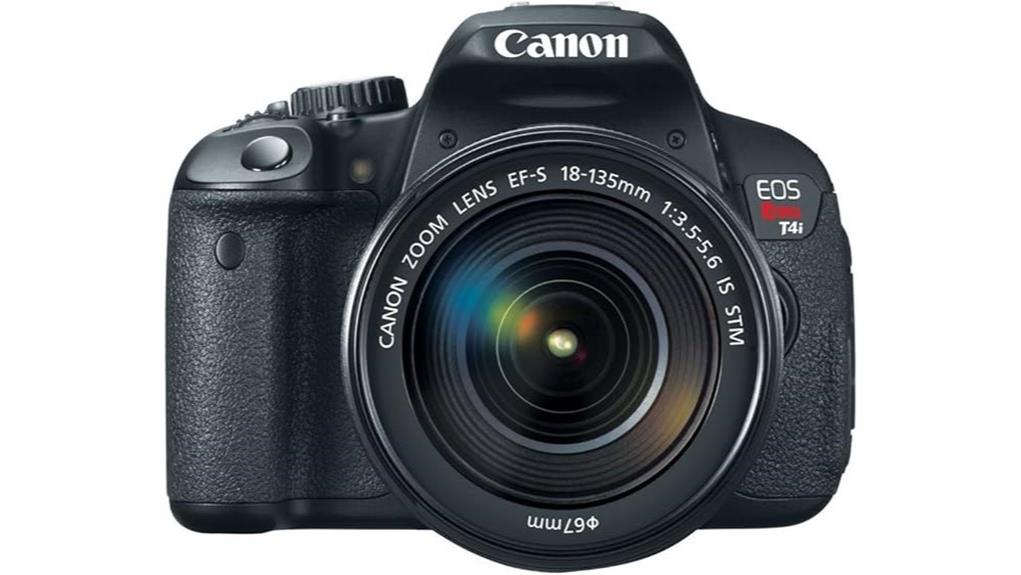
You’ll find the Canon EOS Rebel T4i with the 18–135mm STM is a versatile travel and hybrid-stills/video tool that’s easy to use and technically competent. Its 18MP APS-C sensor with DIGIC 5 and 14-bit A/D gives good color and detail at base ISO, with noise and NR softening above ISO 1600. Hybrid CMOS AF and STM lens enable quiet Movie Servo AF; 9-point AF and 5 fps limit pro action work. Scroll on to see full strengths and trade-offs.
Some Key Takeaways
- 18MP APS-C sensor with DIGIC 5 delivers good image quality and color, though noise reduction softens detail above ISO 1600.
- 9-point all cross-type AF and Hybrid CMOS AF provide reliable phase-detect focusing and improved Live View/movie performance.
- 18–135mm STM lens offers versatile reach and quiet Movie Servo AF, ideal for travel and run-and-gun video.
- Full HD video (1080p30/24/25) with touchscreen vari-angle LCD and external mic jack supports hybrid stills/video workflows.
- Strong all-rounder for travel, family, and hybrid shooters, but not recommended for extreme low-light or pro-level AF/frame rates.
Real-World Performance: Image Quality, Low-Light ISO, and Dynamic Range
Although the 18MP APS-C sensor and DIGIC 5 processor form the core of its image pipeline, you’ll judge the T4i by how that hardware performs in real scenes: color fidelity is strong thanks to 14-bit A/D conversion and effective in-camera processing, with smooth tonal graduations and accurate skin tones; fine detail holds up well at base ISO but softens noticeably as noise reduction kicks in above ISO 1600. You’ll find color accuracy reliable across JPG and RAW, shadow recovery usable but limited by noise, and highlight retention good with conservative metering or HDR Backlight Control. High ISO performance is competent to ISO 1600. Regular sensor maintenance with a proper cleaning kit helps sustain these image-quality characteristics over time.
Autofocus and Shooting Speed: 9-Point AF, Hybrid CMOS AF, and 5 FPS Capture
Tap into the T4i’s autofocus system and you’ll find a practical balance of speed and accuracy: the 9-point all cross-type AF (with a dual-cross f/2.8 center point) delivers reliable phase-detect focusing through the viewfinder for static and moderately moving subjects, while Hybrid CMOS AF accelerates and smooths Live View and movie focus by adding sensor-assist phase detection to contrast AF. You’ll get responsive single-shot focus and effective continuous tracking via AI Servo, though the nine-point array limits subject-lock options compared with denser systems. At up to 5 fps continuous shooting, the camera sustains capture for typical action sequences. If you’re building a kit, consider essential mirrorless-compatible accessories like adapters, lenses, and bags to complement your setup and shooting style, including essential gear.
Video Experience With the 18-135MM STM: Movie Modes, Movie Servo AF, and Audio Options
When you pair the T4i with the 18–135mm STM, the camera delivers versatile Full HD movie options and conspicuously smooth, quiet autofocus that suits run-and-gun shooting as well as narrator-style work. You get 1080p at 30/24/25fps plus 720p at 60/50fps, selectable frame rates for motion control and delivery. Movie Servo AF with STM yields practically silent focusing and steady subject tracking in Live View. Built-in stereo mic offers manual level control, wind filter and attenuator, but you’ll want external audio via the 3.5mm jack for dialog-critical projects and improved dynamic range. For projects where audio quality matters, consider using wireless microphone systems to capture cleaner dialogue and greater mobility.
Handling and Usability: Vari-Angle Touchscreen, Controls, and Lens Integration
Because the T4i pairs a responsive vari-angle touchscreen with familiar physical controls, you get a flexible, fast handling experience that suits both stills and video workflows. You’ll appreciate articulated ergonomics: the 3.0-inch Clear View LCD II swings and tilts for low/high angles and self-recording, while the textured grip and well-placed dials keep one-handed stability. Touchscreen shortcuts speed composition and AF selection, with Touch AF/shutter and quick-menu gestures reducing menu dives. Controls balance novice accessibility and manual precision—dedicated mode dial, exposure comp, and tactile AF point selector. Lens integration with STM delivers quiet, smooth Movie Servo AF and reliable stabilization. For shooters interested in adding stabilization accessories, pairing the T4i with a gimbal stabilizer can greatly enhance smooth handheld video capture.
Buy-or-Skip Verdict: Who the T4i 18-135mm STM Is Best For and Alternatives
You’ll find the T4i with the 18–135mm STM is a strong all-rounder for photographers who want a single versatile kit for travel, family, and hybrid stills/video work. If you prioritize travel versatility, reliable Movie Servo AF, and touchscreen ergonomics, buy it — the STM lens yields quiet focus and useful reach while DIGIC 5 and Hybrid CMOS AF deliver competent low-light and Live View performance. Skip it if you need top-tier low-light ISO, ultra-fast frame rates, or pro-grade AF. Best for enthusiasts doing budget portraiture, vlogging, and travel; alternatives include newer EOS models or used 60D/7D series for more speed. This setup also pairs well with essential DSLR accessories like lenses and bags for photographers on the go.
Some Questions Answered
Does the Camera Support Intervalometer or Built-In Time-Lapse Functions?
No — the camera lacks a built-in interval timer and native exposure ramping for true time-lapse. You’ll need an external intervalometer or third-party firmware/hardware to automate intervals and implement smooth exposure shifts. You can approximate time-lapse manually using Movie Snapshot or continuous shooting, but those methods don’t offer precise interval control or in-camera exposure ramping. For professional results, pair the body with an external intervalometer supporting exposure ramping or use post-processing.
IS There In-Body Image Stabilization or Only Lens IS?
Only lens stabilization is provided; there’s no sensor stabilization. You’ll rely on lens stabilization (Optical Image Stabilizer) for shake reduction, not sensor stabilization. That means stabilization performance depends on the lens you mount—STM and OIS lenses will deliver smooth, quiet correction for stills and video. Evaluate lens choice for low-light or telephoto work, since the camera body offers no in-body sensor stabilization to compensate with any lens.
What Battery Life Can I Expect in Real-World Shooting?
You’ll typically get about 400–500 shots per charge, so battery performance yields moderate shooting duration for all-day casual use but not marathon sessions. With Live View or video, expect 2–3 hours of continuous operation or fewer minutes of full HD recording depending on AF use and LCD brightness. Using power-saving settings, limited Live View, and spare batteries improves real-world shooting duration and keeps performance predictable.
Can the T4I Accept Third-Party Batteries and Memory Cards Reliably?
Yes — you can use aftermarket batteries and third‑party SDs, but you should be selective. Aftermarket batteries often work fine and give comparable runtime, yet cheap cells can underperform, lack protection circuits, or trigger battery errors. Use reputable brands with high-quality cells and reviews. Use Class 10/UHS-I/II third‑party SDs from trusted makers; verify sustained write speeds for video. Test new batteries/cards before critical shoots.
Does the Camera Support Wi‑Fi or Remote Smartphone Control Out of the Box?
No — it doesn’t include built‑in Wi‑Fi or native smartphone control out of the box. You can add wireless adapters (Canon WFT/third‑party) to enable remote tethering and FTP, though functionality and stability vary. App compatibility depends on the adapter and software: some Canon utilities and third‑party apps support basic Live View, remote shutter and file transfer, but you’ll get more reliable, full‑feature control from newer models with integrated Wi‑Fi.