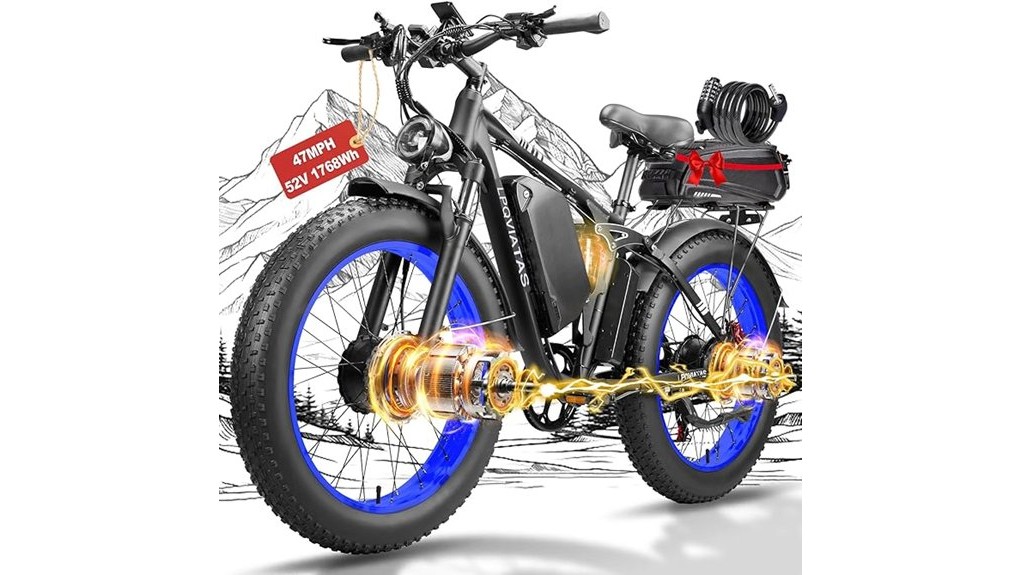
You’re looking at a purpose-built, dual‑motor AWD fat‑bike that prioritizes power, traction, and payload over strict street legality. Its 52V/1768Wh pack and twin 4,500W motors deliver brutal acceleration, sustained hill torque, and 90–105 mile PAS range in moderate use, though full throttle drains range fast. Dual suspension, 24×4.0 tires, and hydraulic discs keep control on snow, sand, and steeps. Keep weight limits, local e‑bike rules, and battery care in mind—more specs and tests follow.
Some Key Takeaways
- Dual‑motor 9,000W peak AWD delivers strong acceleration, 220 N·m torque, and reliable hill‑climb performance on varied terrain.
- 52V 1768Wh (34Ah) battery offers ~90–105 miles PA range under moderate use; aggressive throttle drastically reduces range.
- 24×4.0 fat tires and full suspension (lockable fork, adjustable rear shock) provide traction and comfort on sand, snow, and trails.
- Top speeds ~42–46 mph on flat pavement; legal status depends on local e‑bike class and speed regulations.
- Robust frame supports up to 330 lb payload, includes hydraulic discs, 7‑speed drivetrain, and essential accessories; expect routine maintenance.
Primary Intent and Quick Verdict: Is the EB7PRO 9000W Right for You?
If you need a high‑power, all‑terrain electric bike that can haul heavy loads and tackle steep climbs, the EB7PRO 9000W is built for that role. You’ll get a dual-motor, full-suspension platform optimized for mixed-use: trail, snow, sand, and payload-equipped commutes. Its 24×4.0 fat tires and robust frame favor stability and cargo capacity, so you can rely on it for heavy-duty urban commuting segments. Note legal compliance limits vary by jurisdiction; you’ll need to check local e-bike class and speed rules before road use. Verdict: choose it if you prioritize power, traction, and load capability over strict street legality. The EB7PRO is especially well suited for riders who enjoy outdoor adventures and need durable gear for fat tire ebike activities.
Power, Battery, and Real-World Range: What the 52V 1768Wh Setup Delivers
How far will the EB7PRO’s 52V, 1768Wh battery actually take you? You can expect 90–105 miles with pedal assist under moderate load and terrain; aggressive throttle or full dual-motor use trims range substantially. The 34Ah pack and BMS prioritize battery longevity through balanced cell management. Fast-charging behavior restores capacity quickly but repeated rapid charges raise heat; thermal management is passive with limited active cooling, so allow cool-down cycles after hard use. Regen braking recovers modest energy on descents, extending range marginally. Monitor charge cycles, avoid frequent full-depth discharges, and keep firmware updated for peak performance. This setup complements a range-extender ecosystem for e-bike riders who enjoy outdoor activities and longer trips with battery range extenders.
Ride Handling and Components: Suspension, AWD, Brakes, Gears, and Tires
When you tackle rough trails or urban potholes, the EB7PRO’s suspension and AWD layout work together to keep traction and control. You get a lockable, adjustable front fork and racing-grade mid-mounted rear shock delivering dual shock absorption; suspension tuning is straightforward with preload and rebound adjustments for rider weight and load. AWD torque distribution stabilizes steering inputs and complements the 24×4.0 all-terrain tires for predictable grip. Dual hydraulic disc brakes provide strong stopping power; brake modulation requires a short familiarization period to avoid abrupt engagement. The 7-speed derailleur and thumb shifter offer reliable cadence control without drivetrain lag. Riders who frequently refine wheel alignment and balance will appreciate how these components integrate for overall ride stability and rim truing maintenance.
Performance Tests: Top Speed, Climbing, and Terrain-Specific Capability
Push the EB7PRO hard and you’ll quickly see where its 9,000W peak and AWD layout translate to real-world performance: top speeds of roughly 42–46 mph on flat pavement under ideal conditions, sustained high torque for rapid acceleration, and confident hill-climbing on steep grades thanks to the dual 4,500W motors and peak torque around 220 N·m. You’ll measure consistent torque delivery through full throttle, with minimal sag under load. Acceleration testing shows brisk 0–30 mph sprints and strong midrange pull for overtakes. On sand, snow, and gravel the fat tires and suspension maintain traction and control; expect reduced top speed but preserved climb capability. Designed for outdoor enthusiasts, the EB7PRO pairs high-performance motors with accessories tailored to off-road riders.
Ownership Checklist: Assembly, Accessories, Weight Limits, Warranty, and Who Should Buy
Because you’ll be handling most of the final setup and ongoing checks, start with a clear ownership checklist that covers assembly steps, included accessories, weight limits, warranty terms, and buyer suitability. Follow assembly tips: torque headset/axles, align brakes, install pedals, charge/removable 52V battery, verify display and cable routing. Confirm accessories: light, horn, phone holder, saddle, mudguards, rack, tool kit. Respect maximum 330 lb recommendation and 38.8 kg bike weight when calculating payload. Note limited warranty limits—check coverage duration, battery and motor exclusions. Buy if you need high-power AWD performance and can perform routine maintenance. Keep your ebike battery healthy for outdoor adventures by following recommended charging and storage practices and monitoring battery health with battery care.
Some Questions Answered
Can I Legally Ride This Bike on Public Roads in My Area?
Maybe, but you’ll need to check local regulations and licensing requirements first. High-power 9000W e-bikes often exceed consumer e-bike classifications and may be treated as mopeds or motorcycles, requiring registration, insurance, helmet use, and a valid driver’s license. Review state/provincial and municipal rules for power, speed limits, and where you can ride. Contact local DMV or transport authority to confirm classification and any necessary permits before riding on public roads.
How Loud Are the Motors During Heavy Acceleration?
You’ll hear noticeable motor noise during heavy acceleration, a sharp mechanical whine from dual high‑power motors that rises with throttle. Vibration levels increase too, felt through the frame, handlebars and saddle under peak torque; it’s not harsh but perceptible. Expect audible pitch changes and low-frequency thrum during hard pulls. Mitigation comes from proper mounting, tightened fasteners, and quality grips/seat; regular maintenance reduces both motor noise and vibration levels.
Is the Removable Battery Airline-Transport Compliant?
No — the removable 52V 34Ah (1768 Wh) battery exceeds typical airline restrictions for lithium-ion capacity, so it’s not airline-transport compliant. You’ll need battery certification and airline approval for any exception, but most carriers limit batteries to 100 Wh (carry-on) or 160 Wh with airline approval. For shipping, follow hazardous-materials rules and provide proper documentation. Contact the airline and manufacturer for exact battery certification and permissible transport options.
What Maintenance Schedule Does the AWD System Require?
You should perform regular inspection of the AWD system every 500–1000 miles and after heavy use, plus fluid checks monthly. Inspect motor mounts, wiring, seals, and driveline for wear; torque fasteners to spec. Change gear/transmission fluids (if serviceable) per manufacturer schedule or annually. Clean connectors, re-lubricate moving joints, and test motor temperatures under load. Log service actions and address abnormalities immediately to prevent accelerated wear.
Are Replacement Parts Readily Available From the Manufacturer?
Yes — you can get replacement parts direct, but availability varies by region and stock. You’ll use the manufacturer warranty process for defective items; non-warranty parts may take longer. Verify parts compatibility with frame serial and model (EB7PRO) before ordering. Common items (battery pack, motors, brakes, suspension) are usually serviceable, while obscure trim pieces or proprietary electronics may require dealer assistance or longer lead times.