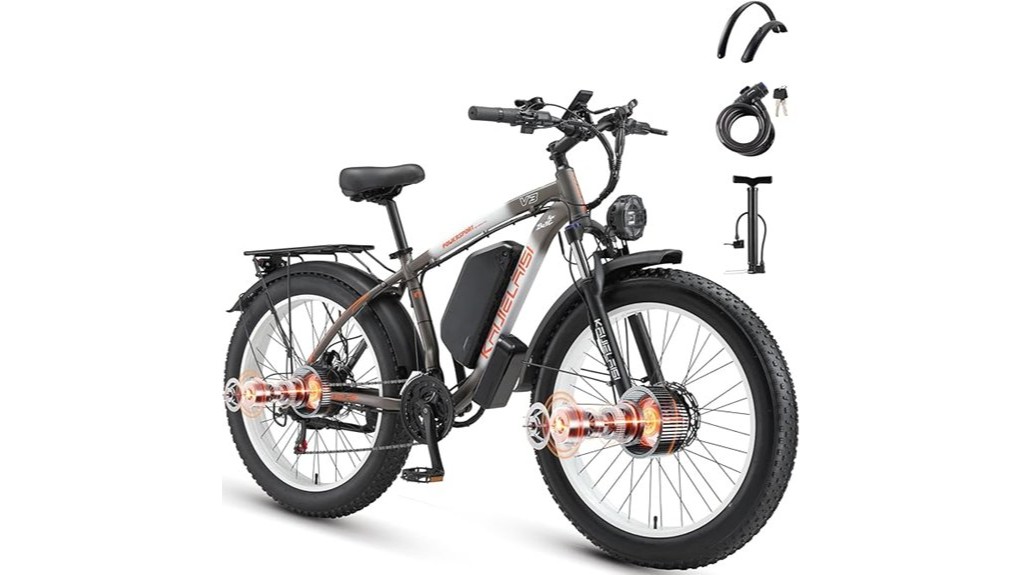
You’ll get brutal off-road power with twin 2,000 W brushless motors (4,000 W peak) and 85 N·m torque, precise modulation, and a 21-speed drivetrain for sustained climbs and cadence control. The removable 1,076–1,104 Wh battery delivers 30+ miles full-throttle or 50+ with assist, with 8–10 hour charges and swap capability. Fat 26″×4″ tires, fork suspension and hydraulic discs make trail handling composed. Keep in mind it’s heavy and purpose-built; more specifics follow.
Some Key Takeaways
- Twin 2,000 W motors (4,000 W peak) provide strong AWD traction and 85 N·m torque for steep climbs and heavy loads.
- 48V, ~1,076–1,104 Wh removable battery offers ~30+ miles full-throttle, 50+ miles with pedal-assist, and 8–10 hour charging.
- 26″ x 4″ fat tires and front suspension deliver stable off-road flotation and controlled handling on sand, snow, and loose dirt.
- 21-speed drivetrain, precise torque management, and configurable speed governors ensure smooth acceleration, cadence control, and traction maintenance.
- At 103 lb with one-year warranty, it’s ideal for rugged trail use and hauling, but bulky and overkill for urban commuting.
Performance and Power: Motors, Torque, Speed Limits, and Hill-Climb Capability
Although it looks like a bulky cruiser, the V3 delivers concentrated grunt: twin 2,000 W brushless motors give you a peak 4,000 W output and 85 N·m of torque, so acceleration feels immediate and sustained under load. You’ll notice precise motor modulation that smooths throttle input across the 21-speed drivetrain. Torque management prevents wheel hop and keeps traction on steep pitches; climb dynamics let you maintain momentum up to advertised 40° inclines when configured. Speed governors are configurable for legal limits and lift protection. Overall, control systems prioritize predictable power delivery, effective hill performance, and rider confidence. The V3 is aimed at riders who want to boost their off-road thrills with high-performance ebike motors, terrain-capable setups, and durable components.
Battery, Range, and Charging: Real-World Miles, Removable Battery Features, and Charging Times
When you push the V3 hard it still delivers more range than you’d expect from a 48V, 22.4Ah pack: the removable, key-locked battery (waterproof and UL 2849–certified) stores about 1,076 Wh nominal (listed 1,104 Wh) and powers mixed riding for roughly 30+ miles in full-throttle electric mode or north of 50 miles using pedal-assist, with actual mileage varying by load, terrain, and ride mode. You’ll swap the battery quickly for charging or security. Expect 8–10 hour fast-charge cycles; follow charging etiquette—avoid deep discharges, keep cells cool, and store at partial charge to preserve battery health. This makes it a solid option for riders seeking replacement ebike batteries tailored to outdoor activities.
Ride Quality and Handling: Suspension, 26 Fat Tires, Brakes, and On/Off-Road Comfort
If you want a bike that soaks up rough ground and still feels planted at speed, the V3 delivers: its 26″ by 4″ fat tires provide large contact patches and low ground pressure for traction on sand, snow, and loose dirt, while the front fork suspension smooths impacts and keeps the wheel tracking over ruts. You’ll feel controlled braking from dual hydraulic discs with predictable modulation and short stopping distances, even wet. The oversized cushioned seat improves seat comfort on long rides. Trail feedback is balanced—big tires mute chatter but still transmit directional cues—letting you push confidence both on- and off-road. These features make the V3 ideal for riders looking to conquer trails with fat eBike tires.
Usability and Controls: Riding Modes, 21-Speed Drivetrain, Motor Switching, and Display/Controls
The V3’s composed ride carries over into an intuitive control layout that puts mode selection and gear range where you can use them without fumbling. You switch between dual-, single-motor, PAS, walking and cruise modes via a hardened handlebar-mounted switch; motor selection is positive and immediate. The thumb shifter and 21-speed drivetrain give precise cadence control across steep and flat sections. Handlebar ergonomics place controls, brake levers and throttle within a short, repeatable reach so you maintain balance while adjusting power. The clean display layout shows speed, battery, assist level and motor mode at a glance for safe, informed inputs. Riders who enjoy outdoor activities will appreciate resources on cycling skills to get the most from their ebike.
Who Should Buy the V3 and Value Checklist: Use Cases, Weight/Portability, Warranty, and Final Verdict
While packed with power and rugged capability, the V3 is best for riders who need true off-road performance and hauling stability rather than quick urban commutes; you’ll appreciate its dual 2,000W motors, fat 26×4″ tires, and 21-speed drivetrain on steep trails, snowy roads, or long mixed-surface adventures. You should buy the V3 if you’re a weekend trail rider, overland explorer, or cargo hauler needing 1,076–1,104 Wh range and 40° climb capability. It’s heavy (103 lb), so portability is limited; warranty is one year with 24-hour support. Verdict: excellent for rugged utility, overkill for urban commuters. Riders who enjoy outdoor activities should also consider essential gear like helmets, repair kits, and protective clothing for safer and more comfortable trail riding with the V3, especially given its focus on mountain ebike use.
Some Questions Answered
Is the V3 Compatible With Front or Rear Child Seats?
Yes — you can fit a rear child seat but front-mounted seats are limited. You’ll need a child helmet compatibility check and to follow seat mounting standards: rear rack must support passenger weight and use proper mounting points on the aluminum frame; avoid fork-mounted front seats because fat tires and suspension change geometry. You should install a certified rack, confirm UL-rated battery clearance, and use manufacturer-recommended anchors, bolts, and harnesses for safe operation.
Can the Battery Be Flown or Shipped Internationally?
No — you can’t simply fly the battery as passenger luggage. The removable 48V 22.4Ah pack is treated as hazardous materials; airline restrictions limit lithium batteries by Wh and require carrier approval, special packaging, and documentation. For international shipping you’ll need a freight forwarder or courier that handles hazardous materials and follows IATA/ICAO and local customs rules. Contact support for UL 2849 certs, packing instructions, and carrier options before booking.
What Accessories (Racks/Fenders) Are Officially Supported?
You get official rack compatibility for rear cargo racks that bolt to the seatpost and rear triangle; load ratings match the V3’s frame and recommended payload. Fender options include full-coverage polyethylene 4″ fenders matched to the fat tires and bolt-on splash guards for front fork mounts. You’ll also find optional integrated rack–fender combos sold by the maker. Install follows supplied mounting points; use provided hardware and torque specs.
How Loud Are the Motors at Full Power?
You’ll hear noticeable motor noise at full power, but it’s not deafening. Measured decibel levels typically sit around 70–78 dB at peak throttle under load, so you’ll notice a firm whine and gear/mechanical harmonics. The dual brushless setup produces broadband motor noise plus drivetrain artifacts; vibrations are managed by the chassis and fat tires. You’ll want hearing protection only for prolonged close-range testing sessions.
Are Replacement Parts or Upgrade Kits Available?
Yes — you can get spare components and upgrade pathways for the bike. You’ll source OEM parts (motors, battery modules, hydraulic discs, fork) through the manufacturer/support, aftermarket vendors, and specialty ebike shops. You’ll also find upgrade pathways like higher-capacity batteries, stronger motors, improved suspension, and larger brake rotors. Keep serial/model info handy, verify compatibility, and use professional installation for powertrain or battery upgrades to maintain safety and warranty.