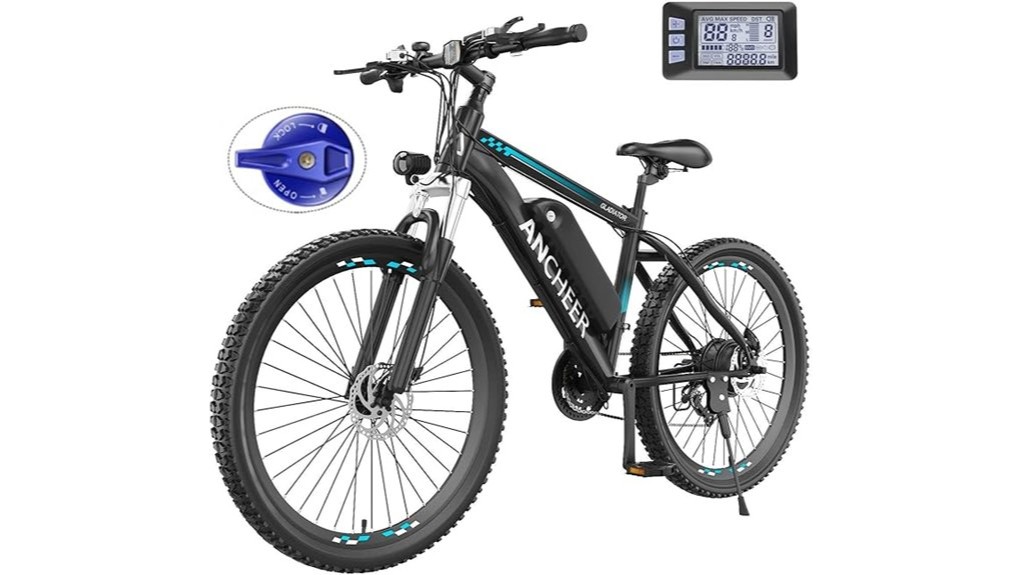
You’ll get a practical 26″ e‑bike with a 48V brushless hub motor rated 500W nominal (750W peak), five pedal‑assist levels, a throttle, and cruise that kicks in above 6 mph. Range depends on battery choice (374Wh or 499Wh up to ~50 miles), and charging is about 3–3.5 hours. Frame geometry and 26″ wheels give stable handling; mechanical discs and 3×7 drivetrain cut cost but limit climbing finesse. Keep going to see full spec and tradeoffs.
Some Key Takeaways
- 48V brushless hub motor delivers 500W nominal and 750W peak for smooth acceleration and top speeds up to 22 mph.
- Five pedal-assist levels plus throttle and cruise control provide versatile power delivery and immediate response.
- Available 374Wh or 499Wh removable batteries (499Wh ≈ up to 50 miles PAS) charge in about 3–3.5 hours.
- 26″ geometry, front suspension, and mechanical disc brakes suit mixed terrain but limit heavy off-road/climb performance.
- Good value for commuters seeking a practical, UL-certified e-bike with removable battery and throttle; consider mid-drive alternatives for intense climbing.
Performance and Power: Motor, Speed, Throttle vs Pedal-Assist, and Cruise Control
When you push the Ancheer Peak, its 48V brushless hub motor delivers a 500W nominal output with 750W peak torque, letting the bike reach up to 22 mph while maintaining smooth power delivery. You’ll notice consistent torque delivery across throttle and five pedal-assist levels; throttle gives immediate full-power response, assist scales output with cadence and selected level. Cruise control engages automatically at ≥6 mph for steady-state riding. The controller’s thermal management prevents sustained overheating during repeated boosts, sacrificing peak output if needed. Overall, the system balances responsiveness, efficiency, and component protection for predictable on-road performance. This setup makes the Ancheer Peak a solid choice for ebike riders who enjoy outdoor activities.
Battery, Range, and Charging: 374Wh vs 499Wh, Removable Lockable Battery, and Charge Time
After feeling how the motor delivers power, you’ll want to know how far and how quickly the Peak will take you on a single charge. You can choose a 374Wh or 499Wh 48V lithium pack; the 499Wh (10.4Ah) targets up to 50 miles in pedal-assist. The removable, lockable battery lets you charge on or off the bike and simplifies security. Fast-charge tech fills the pack in roughly 3–3.5 hours. Expect typical battery lifespan with proper care; follow recommended charging cycles and storage. PX54 connector and UL2849 compliance support charging safety and system reliability. The seller specializes in replacement ebike batteries for riders who enjoy outdoor activities and offers guidance on choosing the right pack for outdoor rides.
Ride Feel and Components: Frame, 26 Wheels, Front Suspension With Lockout, Drivetrain, and Brakes
The Peak’s 26″ frame feels stable and predictable, letting you push through mixed terrain without twitchiness; its wheel size balances agility and roll-over ability for urban streets and light trails. You’ll notice balanced frame geometry that keeps weight centered over the hub motor, aiding traction and predictable steering. The front suspension with lockout isolates chatter and saves pedaling efficiency when locked. The 3×7 drivetrain gives a wide cadence range though shifts aren’t as crisp as high-end systems. Mechanical disc brakes provide reliable modulation and easy maintenance. Pay attention to tire durability—stock rubber suits mixed surfaces but consider upgrades for heavy off-road use. If you ride trails often, consider packing essential protective gear for comfort and safety.
Controls, Display, and Usability: ABS LCD, Assist Levels, Throttle/Cruise Operation, PX54 Connector, Assembly, and Daily Use
Moving from ride components to cockpit tech, the Peak’s ABS digital LCD and control cluster give you a straightforward interface for managing power and feedback while riding. You’ll find an intuitive button layout: +/- for assist, mode for throttle, and a long-press “-” for cruise. Menu navigation is logical, showing battery, voltage, speed, mileage, and assist level. The PX54 connector secures wiring with a solid waterproof rating and dustproof seal. The removable battery uses a keyed lock mechanism for security. Assembly is minimal with video guidance, and daily use proves reliable, predictable, and easy to operate. The bike pairs well with colorful ebike display accessories for riders who enjoy outdoor activities and want to personalize their cockpit, especially options highlighting colorful displays.
Who Should Buy This Bike and Alternatives: Ideal Rider Profiles, Strengths/Weaknesses, Price-Value Verdict, and Comparable Models
If you want a versatile, commuter-friendly e-bike that can handle hills and light off-road trails without blowing your budget, the ANCHEER Peak is worth considering: its 48V 500W nominal (750W peak) hub motor, 3×7 gearing, and front suspension with lockout give you practical power and range flexibility, while the removable 499Wh battery and five-level pedal assist support rides up to about 50 miles in efficient use.
You should buy it if you prioritize commuter ergonomics, throttle option, and simple maintenance. Strengths: value, cargo compatibility, removable battery, UL certification. Weaknesses: mechanical discs, hub motor limits on long climbs. Alternatives: mid-drive commuter e-bikes or higher-spec hub models. Price-value: strong for budget-conscious riders seeking versatility. This bike is well suited to riders who enjoy outdoor activities and urban commuting and want gear tailored to adult ebikes with a focus on commuter ergonomics.
Some Questions Answered
Does the Bike Come With a Warranty, and What Does It Cover?
Yes — you get a warranty; the warranty duration typically covers the frame and electrical components for a manufacturer-specified period and provides support for defects in materials and workmanship. It excludes damage from misuse, collisions, normal wear, unauthorized repairs, and consumables (tires, brake pads, battery degradation beyond rated cycles). You’ll need proof of purchase and may face shipping or labor limits; check the specific policy for precise coverage exclusions.
Can the Battery Be Upgraded or Replaced With Third-Party Cells?
Yes — you can replace the battery, but compatibility matters. You’ll need a pack matching the bike’s 48V system, PX54 connector, and similar dimensions; third party packs can work if cell chemistry (Li‑ion spec and 10.4Ah/374–499Wh variants) matches. Be aware installing non‑OEM cells may void the pack warranty and affect BMS/charging behavior. You should verify electrical specs and consult support to make certain safe integration and preserve system functionality.
Is the Bike Legal for Use in My Local E-Bike Classification?
Probably not universally — you’ll need to check local definitions and speed limits. With a 48V 500W nominal (750W peak) motor and up to 22 mph, some jurisdictions classify it as pedelec or low-speed e-bike, others as moped/vehicle needing registration, insurance, or licensing requirements. Helmet laws vary; some require helmets for all e-bikes. Confirm your state/country rules against motor wattage, top speed, and pedal-assist limits before riding.
What Is the Total Assembled Weight and Cargo Capacity?
The total weight is about 62–68 lb assembled, and you’ll find a cargo capacity around 220–265 lb including rider and gear. You’ll carry typical payloads safely on the frame and rear rack, but expect range and handling to drop as weight increases. Check exact specs for your battery option and accessories; heavier batteries and racks raise total weight while slightly reducing cargo capacity and affecting suspension and braking performance.
Are Replacement Parts and Accessories Readily Available Locally?
Yes — you’ll find replacement parts and accessories reasonably available locally and from aftermarket suppliers. Local shops stock consumables (brakes, tubes, chains), basic drivetrain and mechanical disc brake components, and batteries or compatible chargers through distributors. For motor, display, PX54 connectors or proprietary items you’ll rely on aftermarket suppliers or online dealers; warranties and tech support help, but expect longer lead times and occasional compatibility checks.