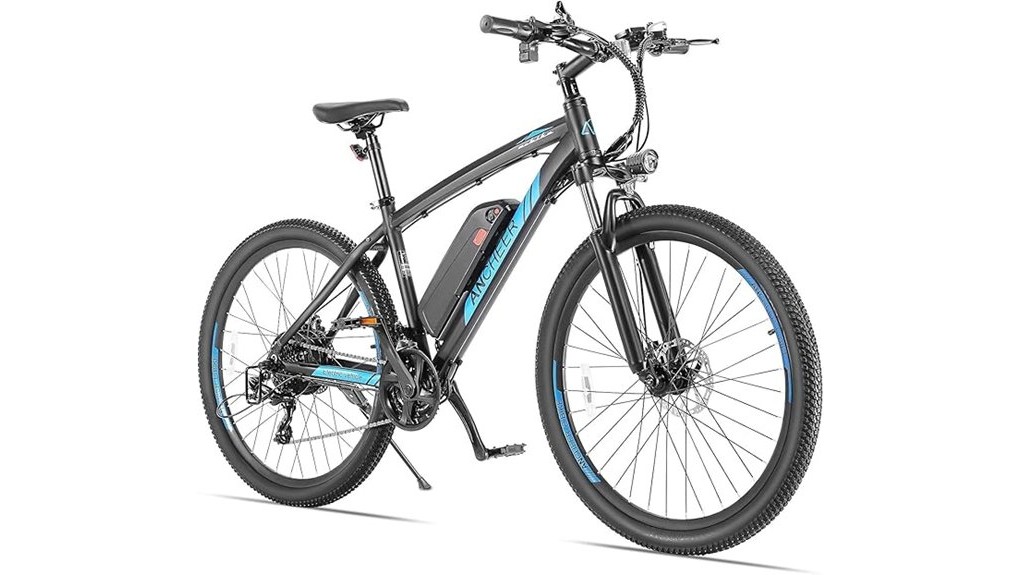
You’ll find the ANCHEER Peak 750W a practical, commuter-focused eMTB that balances usable power and everyday reliability. It pairs a 500W continuous/750W peak motor with a removable 48V 10.4Ah (499Wh) battery, 27.5″ wheels, lockable fork, and upright Hummer-style geometry for stable handling. Expect about 25–55 miles depending on assist, brisk 20 mph top assist, and predictable torque with controlled hill climbing. Keep basic tools and a spare tube, and continue here for full performance and ownership details.
Some Key Takeaways
- Motor: 500W continuous (750W peak) brushless motor delivers brisk acceleration and a 20 mph assisted top speed for commuter and light off-road use.
- Battery & range: Removable 48V/10.4Ah (499Wh) battery charges in ~3–3.5 hours and yields about 25–55 miles depending on assist and terrain.
- Frame & ride: Hummer-style geometry with 27.5″ wheels and lockable front fork prioritizes stable, upright commuter comfort over aggressive trail performance.
- Controls & display: Smart color LCD, five-level PAS, throttle, cruise, and diagnostics provide intuitive control with predictable torque scaling.
- Ownership & value: ~85% pre-assembled, one-year warranty, UL/SGS certification claims, and replaceable battery options make it a practical, affordable commuter eMTB.
Quick Verdict and Who the ANCHEER Peak 750W Is For
While the ANCHEER Peak 750W blends a robust 500W continuous (750W peak) motor and a removable 48V/10.4Ah battery into a durable, Hummer-style eMTB frame, it’s best suited for riders who want reliable commuter and light off-road capability rather than extreme performance. You’ll appreciate commuter practicality: predictable range, quick charging, and upright geometry that eases daily use. For weekend explorers, Adventure compatibility shows in wider tires and a lockable fork that handle variable terrain. You should expect balanced power delivery, clear controls, and solid build quality, not race-grade speed or enduro-level suspension. It’s also a good idea to carry essential items like a spare tube and basic tools for trailside repairs, emphasizing the importance of essential gear for mountain e-bike riders.
Key Specs at a Glance : Battery, Motor, Range, and Frame
Because the ANCHEER Peak pairs a 48V 10.4Ah (499Wh) removable battery with a 500W continuous/750W peak brushless motor, you’ll get a clear picture of its practical capabilities: quick charging (about 3–3.5 hours), an estimated 25–55 mile range depending on assist level and terrain, and a top assisted speed capped at 20 mph for legal compliance. You’ll appreciate the removable pack for charging convenience and monitoring battery lifespan; routine cycles and storage habits will dictate longevity. The 27.5″ wheel, lockable fork, and Hummer-style frame geometry prioritize stability and predictable handling across mixed surfaces without overstating performance. For riders who enjoy outdoor activities, choosing the right replacement pack can extend ride time and reliability, especially when considering replacement ebike batteries.
Real-World Performance : Speed, Hill Climbing, and Ride Quality
Having covered the specs that set expectations, let’s look at how the ANCHEER Peak performs on real roads and trails. You’ll see its 750W peak (500W continuous) reaches the advertised ~20 mph assisted top speed on flat pavement with brisk acceleration. Torque delivery is predictable: initial surge from throttle then steady pedal-assist scaling across PAS levels. Hill climbs on 10–15% gradients remain controlled, though sustained steep grades reduce range noticeably. Suspension compliance from the lockable front fork soaks small bumps and preserves traction; larger hits reveal limits. Overall ride quality balances commuter efficiency with modest off-road capability. For riders who enjoy outdoor activities, choosing the right tire can make a big difference in traction and comfort on varied terrain, especially when selecting trail ebike tires matched to your typical routes.
Controls, Modes, Display, and Ease of Use
When you tap into the ANCHEER’s control suite, you’ll find a clear, functional layout that prioritizes straightforward operation over flashy extras. You get a smart color LCD user interface that clearly shows speed, mileage, voltage, battery level, and error codes for quick diagnostics. Four ride modes (five-level PAS, throttle, cruise, pure pedal) are logically accessed; switching is intuitive. Throttle ergonomics are solid—thumb placement feels natural and response is predictable, though initial calibration may feel abrupt. Overall, controls balance simplicity with diagnostic depth, making everyday use efficient for commuters and recreational riders without steep learning curves. Many outdoor riders prefer displays designed specifically for ebike display screens because they offer durable, readable interfaces suited to varied conditions.
Ownership Checklist : Assembly, Charging, Warranty, and Value for Money
The clear controls and straightforward display set expectations for what you’ll handle after purchase, but ownership involves a few more practical steps. You’ll follow an assembly checklist—attach front wheel, handlebars, pedals, and secure battery—using the video if needed; about 85% arrives pre-assembled. Charge the 48V 10.4Ah battery with fast-charge tech (3–3.5 hours) and use on/off charging to reduce theft risk. Warranty covers motor, battery, and main parts for one year with lifetime technical support; SGS/UL certification adds confidence. Evaluate value for money by comparing range, motor power, and build quality against competitors. For reliable charging and extended battery life, consider choosing an ebike charger with UL certification and appropriate amperage for your battery.
Some Questions Answered
Does the Battery Lock System Prevent Easy Theft of the Removable Pack?
Yes — the keyed lock with a recessed latch reduces casual theft by requiring a key and hiding the release mechanism. You’ll still be able to remove the 48V 10.4Ah pack for charging, but determined thieves with tools could still force it if the battery isn’t stored securely. You should lock the bike, use additional security (frame lock or cable), and avoid leaving the removable pack unattended in public to minimize risk.
Can I Install a Rear Rack or Child Seat on the Frame?
Yes — you can install a rear rack and use many child seats, but confirm specifics first. The frame includes rear rackmounts for straightforward rack attachment; choose a rack rated for the bike’s payload and wheel size. For child seatcompatibility, pick seats designed for 27.5″ e-bikes and verify mounting points, weight limits, and clearance with the battery. Always follow manufacturer torque, safety guidelines, and local regulations when fitting racks or child seats.
Are Replacement Batteries and Parts Readily Available Internationally?
Yes — you can generally find replacement batteries and parts, but availability varies by region. You’ll check battery availability through the manufacturer and third-party sellers; international shipping often exists but can add cost and delays. Aftermarket compatibility is decent for common parts (tires, brakes, racks), though proprietary batteries or connectors may limit options. For long term support, confirm warranty, spare-part stocking, and seller responsiveness before buying.
Is the Bike Compatible With 3rd-Party Lights and Bike Computers?
Yes — you can fit third-party lights and bike computers, but check specifics. The handlebar mounts accept standard clamp sizes, so most lights and head units will attach. Sensor compatibility depends on the display and bike sensors: the PX54 connector and LCD use common signals, but non‑OEM sensors (cadence, speed) may need adapters or mapping. You’ll want to verify pinouts and mounting clearances before purchasing to avoid compatibility issues.
What Is the Total Curb Weight With Battery Installed?
The total curb weight with the battery installed is about 62–66 lbs. You’re getting the curb weight figure that includes the removable 48V 10.4Ah battery, motor and standard accessories. That range accounts for manufacturing tolerances, added options like lights or racks, and heavier component variations. If you need a precise number for your unit, weigh the bike on a luggage scale or check the seller’s spec sheet for the exact total weight.