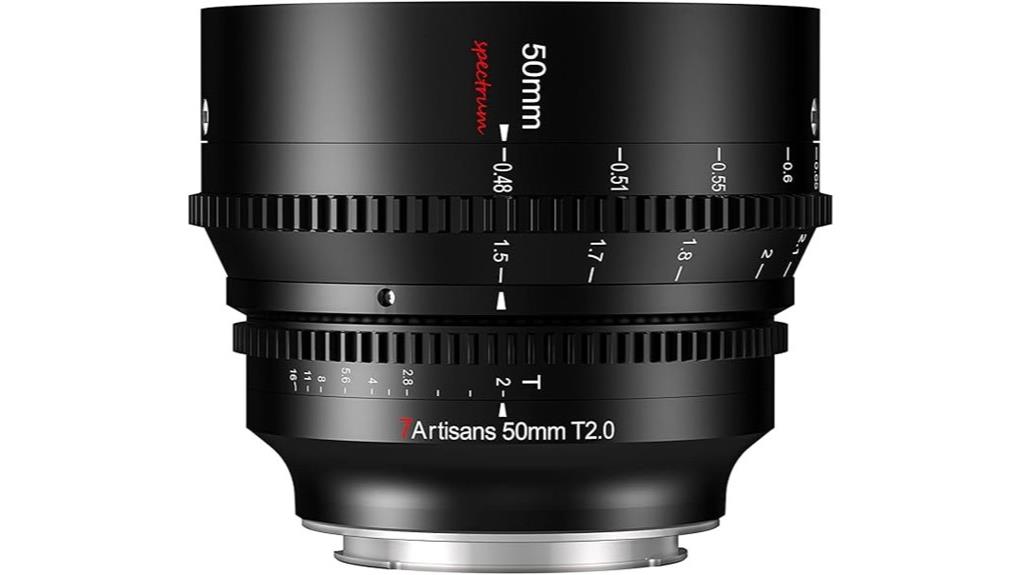
You’ll get a compact, cinema‑style 50mm that’s tuned for manual filmmaking on full‑frame L‑mount bodies. It offers a true T2.0 aperture, strong center resolution at T2.0–T4, restrained flare and controlled chromatic aberration, plus creamy bokeh from 12 rounded blades. The 270° stepless throw and geared ring suit follow‑focus rigs, while metal construction and seals handle production use. It’s a cost‑effective choice for interviews and narrative work — keep going to see detailed optics, handling, and alternatives.
Some Key Takeaways
- Bright constant T2.0 yields shallow depth of field and reliable low‑light exposure for full‑frame L‑mount bodies.
- Strong center resolution at T2.0–T4 with moderate corner improvement when stopped down; good for portraits and narrative.
- Controlled chromatic aberration, restrained flare, and predictable highlight bloom suit grading workflows.
- 270° stepless focus throw, geared ring, and metal construction deliver precise, repeatable manual focus for cinema use.
- Good value for indie filmmakers seeking tactile cinema ergonomics; consider AF alternatives or renting for run‑and‑gun needs.
What the 7Artisans 50mm T2.0 L‑Mount Lens Is and Who It’s For
Because it pairs a bright T2.0 aperture with cine-grade mechanics, the 7artisans 50mm T2.0 L‑Mount is a manual-focus cinema lens aimed at filmmakers and hybrid shooters who prioritize optical character and precise control over autofocus convenience. You’ll find it’s built for disciplined shooting: long 270° focus throw, geared rings, and durable construction that integrate with cinema ergonomics and follow-focus systems. It’s for operators who value tactile feedback and predictable rendition over autofocus speed. Expect streamlined user workflow when pairing with L‑mount bodies set to release without lens, enabling robust manual operation across video and stills production. The company also supports photographers using lens adapters to expand mount compatibility with other camera systems.
Key Optical Specs and Real‑World Image Quality Tests
When you push the 7artisans 50mm T2.0 into practical use, its optical pedigree—ED and high‑refractive‑index elements and a design tuned for full‑frame coverage—delivers particularly crisp center resolution at T2.0 with controlled chromatic aberration and smooth falloff toward the edges. You’ll measure strong chromatic resolution with minimal lateral CA; longitudinal color shift is subdued. Sharpness mapping shows peak center sharpness at T2.0–T4 and moderate corner improvement stopped down. Field curvature is shallow but measurable, so focus plane tuning matters for wide scenes. Practical flare is restrained; contrast holds under backlight, with predictable highlight bloom for grading. For many users, pairing the lens with a quality top handle improves handling and comfort during longer handheld shoots, especially when composing tight or moving shots with a longer prime better camera grip.
Aperture, Bokeh, and Low‑Light Performance on Full‑Frame Bodies
Having established its center sharpness and controlled aberrations, let’s evaluate how the 50mm T2.0’s aperture behavior and diaphragm design affect bokeh rendering and low‑light usability on full‑frame bodies. You’ll find the constant T2.0 delivers predictable exposure and shallow bokeh for subject isolation while 12 rounded blades produce circular defocus and creamy highlights with minimal onion rings. The lens holds contrast wide open, aiding night shooting without aggressive flare. In practical low‑light scenarios you can rely on T2.0 for usable shutter/ISO combinations; stop down tightens microcontrast and background discipline, but at the cost of reduced separation and smoother tonal shift. Reflectors and modifiers can further shape and control the light for more polished portraits with this lens, especially when working with full‑frame sensors and shallow depth of field using photo reflectors.
Focusing Mechanics, Build Quality, and Compatibility Notes
Although compact, the 7artisans 50mm T2.0 gives you pro-grade focusing control with a 270° stepless throw that lets you make fine, repeatable adjustments for critical focus pulls. You’ll appreciate the smooth mechanics—motion is damped without backlash, and the geared focus ring mates cleanly with follow-focus systems for precise, repeatable pulls. Build quality leans toward rugged durability: metal construction, well-sealed mounts, and consistent torque across the throw. Lens compatibility is straightforward for L‑mount bodies (Sigma FP, Panasonic S1/S1H/S5, Leica SL/SL2) but remember to set cameras to release without lens for operation. Overall: dependable, cinema-oriented. Consider pairing the lens with custom camera foam to protect your gear during transport and storage.
When to Buy This Lens: Use Cases, Alternatives, and Value
Consider this lens if you need a compact, cinema-grade 50mm that prioritizes manual control and optical clarity for full‑frame L‑mount bodies. You should buy it when you require reliable T2.0 performance, accurate manual focus with 270° throw, and reduced chromatic aberration for interview, narrative, or short‑form commercial work. If you’re on a tight budget, evaluate budget alternatives — faster autofocus primes may cost more but ease run‑and‑gun shoots. For occasional projects, adopt a rental strategy to access higher‑end cine glass or specialty focal lengths. Overall value favors indie filmmakers and camera operators who prioritize tactile control and image character. Consider pairing it with a sturdy tripod head optimized for fluid pans and tilts, such as a fluid head, to maximize stability and smooth motion.
Some Questions Answered
Does This Lens Come With a Lens Hood or Case?
No—you won’t get a lens hood or protective case in the box. Included accessories are limited to basic items (check retailer for specifics), so you’ll need to buy a lens hood and protective case separately to shield the optic and body. You’ll want a snug protective case that fits the manual-focus ring and 270° focus throw, and a hood that avoids vignetting at T2.0 while minimizing flare for critical cine work.
Is There Any Weather Sealing on the Lens Body?
No, there’s no specified weather protection or formal moisture resistance rating on the lens body. You should treat it as unsealed: avoid rain, heavy humidity, and dusty environments without additional protection. Mechanically it’s robust for studio and controlled-location work, but it lacks gasketed mount or sealed controls for reliable outdoor weatherproofing. If you need weather resistance, plan for protective covers or use a sealed camera system and cautious handling to mitigate exposure.
What Is the Lens Weight and Exact Dimensions?
The lens weighs 480 grams, and its precise dimensions are 72 mm diameter × 90 mm length (from mount flange to front). You’ll find the compact weight balances well on mirrorless bodies, and the precise dimensions support rigging with matte boxes and follow-focus gear. You’ll appreciate the form factor for handheld and gimbal use; it’s compact yet substantial enough to feel robust, with dimensions that integrate cleanly into professional cinema workflows.
Can This Lens Be Adapted to Non‑L Mounts Safely?
Yes — you can adapt it to non‑L mounts using a proper mount adapter, but you’ll need to confirm flange calibration and mechanical fit. You’ll retain manual focus and aperture control, but check adapter registry, tolerance, and secure mounting to avoid stress on the lens mount. Optical performance stays intact; infinity focus depends on precise flange calibration. Avoid cheap adapters that introduce play or incorrect flange distance.
Are There Electronic Contacts for Metadata or Aperture Control?
No — there are no electronic contacts for metadata or aperture control. You’ll rely on mechanical coupling and a manual aperture, so the camera won’t receive lens data or control iris. That means no EXIF focal/ aperture info and no in-camera aperture adjustments. You’ll set T-stop on the lens and use camera “release without lens” mode if needed. For precise exposure logging, plan external recording or manual metadata entry.