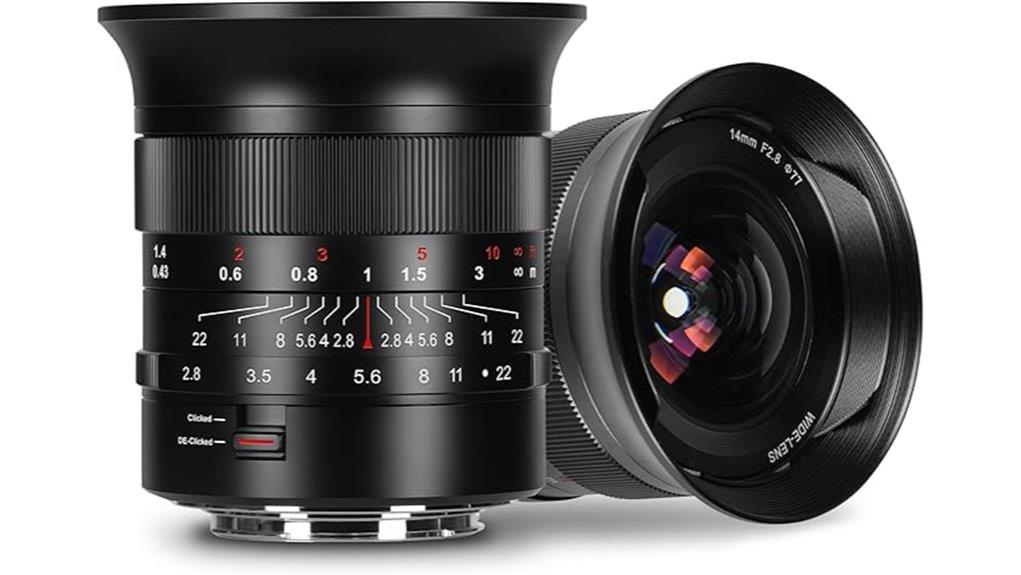
You’ll get a hard‑stop, all‑manual 14mm f/2.8 with a 116° view that delivers strong center sharpness wide open, modest corner improvement by f/5.6–f/8, and restrained geometric bokeh at close focus. The metal barrel and long, damped focus throw suit precise architectural, interior, and astro work, though there’s no AF, stabilization, EXIF, or electronic aperture control. Expect mild barrel distortion and some veiling with direct sun — more technical findings follow below.
Some Key Takeaways
- Ultra-wide 14mm f/2.8 manual lens excels for architecture, interiors, astrophotography, and creative wide-angle work on Canon RF bodies.
- Strong center sharpness at f/2.8 with improved corners and reduced field curvature by f/5.6–f/8.
- Manual-focus with long, damped throw and effective focus peaking enables precise focusing but requires verification.
- Shows mild edge shading and barrel distortion (correctable in RAW); acceptable flare control with occasional veiling.
- No autofocus, stabilization, or EXIF communication, but offers excellent optical value and compact handling for the price.
Verdict Up Front: Is the 7artisans MF14mm F2.8 Worth It?
Bottom line: if you need an ultra-wide, fast manual lens for architecture, interiors, astrophotography, or creative wide-angle work on Canon RF bodies and you’re comfortable focusing by hand, the 7artisans MF14mm F2.8 delivers strong optical value for the price. You’ll appreciate solid build quality with metal barrel and precise, damped focus throw. Handling ergonomics suit tripod and handheld use despite no stabilization. Optics yield restrained bokeh character at close focus and strong edge-to-edge sharpness stopped down. Color rendering is neutral with minimal tint, letting you calibrate profiles in post. It’s a purpose-driven tool, not a do-everything lens. The lens is an attractive option for mirrorless photographers seeking essential accessories and specialty glass for their camera systems, especially those focused on mirrorless camera applications.
What the Specs Actually Mean for Image Quality and Low‑Light Use
Having established the lens’ strengths and intended uses, let’s examine how the MF14mm F2.8‘s specifications map to real-world image quality and low‑light performance. You get a wide 116° field and f/2.8 aperture that favors short exposures and lower ISO, improving noise performance versus slower ultra-wides. Optical formula (aspherics, HR and LD elements) controls aberrations, so exposure latitude stays usable for highlights and shadows during post. Depth rendering is inherently expansive at 14mm, so foreground-to-background separation is subtle; bokeh character appears restrained and geometric. Lack of stabilization means you’ll rely on shutter speed or tripod for clean low‑light results. This lens is aimed at photographers who enjoy portraiture and want portrait camera lenses tailored to their style.
Real‑World Performance: Sharpness, Distortion, Flare, and Autofocus Workflow
When you test the 7artisans MF14mm F2.8, sharpness is strong in the center from wide-open with microcontrast holding up well, while corners tighten noticeably by stopping to f/5.6–f/8; expect modest field curvature that benefits from careful focusing rather than relying on hyperfocal estimates. In practice you’ll see mild edge shading at f/2.8 that reduces by f/4, and barrel distortion is present but correctable in raw converters without severe resolution loss. Flare control is acceptable with some veiling on direct sun. Manual-focus workflow depends on lens throw and focus peaking usability — peaking is effective but verify critical focus visually. This lens is well suited for enthusiasts shooting wildlife and sports who need reach and portability with manual control telephoto techniques.
Who This Lens Is Best For and Top Shooting Scenarios (Architecture, Astro, Video)
If you need an ultra‑wide, full‑frame manual lens that prioritizes optical reach and control over automation, the 7artisans MF14mm F2.8 is aimed at experienced photographers and hybrid shooters who can work with manual focus and want a compact, affordable solution for architecture, interiors, astrophotography, and creative wide-angle video. You’ll benefit from 116° coverage, robust optical formula, and a minimum focus of 0.43m for tight interiors. Use it for architecture and interiors where rectilinear control and landscape storytelling matter, for astro where f/2.8 and low-dispersion elements reduce coma, and for video where stepless aperture enables smooth exposure shifts and creative perspectives. It’s especially well suited to photographers who enjoy exploring exaggerated perspectives and creative distortion with fisheye lenses.
Buy vs. Alternatives: Canon RF Options and Third‑Party Tradeoffs
Weighing the MF14mm F2.8 against Canon’s native RF options and other third‑party ultra‑wides comes down to a tradeoff between manual control, cost, and optical/ergonomic integration: you get a compact, optically ambitious 14mm with strong AOV and a complex element set for aberration control, but you give up autofocus, in‑body/optical stabilization, weather sealing, and lens‑body communication that native RF lenses provide for features like electronic aperture control, EXIF, and autofocus‑assisted framing. For a price comparison, the 7artisans undercuts RF primes substantially. Assess build quality versus native robustness; consider longer focus throw that aids precision but slows action work. Note weight tradeoffs: lighter lens, less balance on pro bodies. The MF14mm also pairs especially well with compact mirrorless bodies for travel and landscape shooting thanks to its small footprint and manual focus precision, making it a strong pick for photographers prioritizing portable setups.
Some Questions Answered
Does It Accept Standard Screw-On Filters Without Adapters?
No — you can’t use standard screw-on filters directly because the front element is deeply curved; filter compatibility requires dedicated front-mount accessories. You’ll attach specialized bayonet or adapter filters that avoid physical vignetting and preserve edge sharpness across the frame. Using proper adapters you retain vignetting control and maintain optical performance; using improper screw-on filters will cause severe corner shading and degrade edge resolution, especially at wide apertures.
Is There Any Electronic Communication With the Camera Body?
No — there’s no electronic communication with the camera body. You’ll use manual focus only; focus and aperture are mechanically controlled without EXIF transmission or autofocus signaling. Rangefinder coupling isn’t present as an electronic link; if any coupling exists it’s purely mechanical or optical for manual framing aids. Expect no in-body lens data, no electronic aperture control, and no focus confirmation from the camera — you’ll rely on your own manual techniques.
How Durable Is the Lens Mount and Build Quality?
You’ll find the mount is metal and feels robust, resisting metal fatigue under normal use but lacking active reinforcement for heavy repeated stress. The overall build is solidly machined with precise tolerances, yet there’s no weather sealing, so you shouldn’t expect protection against moisture or dust ingress. Internals use quality glass and metal helicoids, offering durable mechanical action, but avoid harsh environments and heavy bayonet strain to prevent long-term wear.
Can the Aperture Ring Be De-Clicked for Silent Video Use?
Yes — you can de-click the aperture ring for silent video use. You’ll perform a manual override via the aperture switch to toggle between stepped (clicked) and stepless (clickless conversion) modes. In stepless mode the ring provides smooth, quiet iris changes ideal for video; it’s a mechanical/manual override rather than electronic. You’ll still adjust exposure manually, and the conversion preserves tactile control while minimizing audible clicks during recording.
Is There a Service or Repair Center for Canon RF Versions?
Yes — you can use authorized service and third party repair options for Canon RF versions. You’ll first contact 7artisans or the vendor to confirm authorized service centers for RF mounts; they’ll route warranty work. For out-of-warranty or faster turnaround, you can use experienced third party repair technicians familiar with RF mount calibration and electronic mount interfaces. Keep proof of purchase and document lens serial and symptoms for efficient diagnostics and repair authorization.