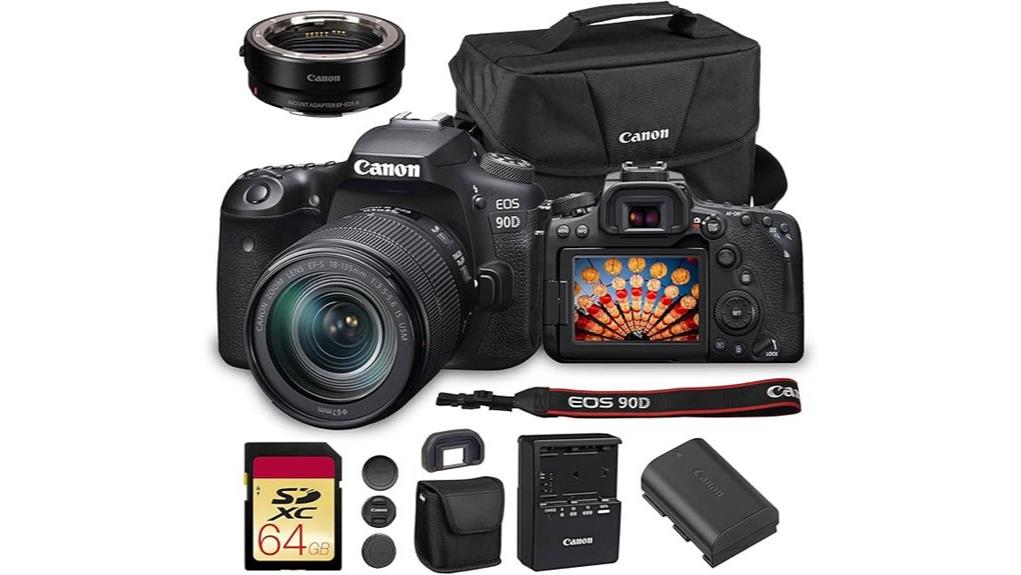
You’ll get a high-resolution 32.5MP APS‑C body with 10 fps bursts and Dual Pixel AF that pairs well with the 18–135mm f/3.5–5.6 IS USM for wildlife, sports, and travel. Autofocus and NANO USM deliver reliable subject acquisition and tracking at short to medium ranges, while 4‑stop stabilization helps handheld framing. Image quality is strong to ISO 3200–6400 and UHD 4K30p is usable. Keep a spare battery and teleprime for extended reach; more specifics follow.
Some Key Takeaways
- 32.5MP APS‑C sensor and DIGIC 8 deliver high-resolution files ideal for cropping and detailed travel, wildlife, and sports images.
- 10 fps continuous burst with reliable AF tracking handles fast action, though buffer depth limits very long sequences.
- Bundled 18–135mm f/3.5–5.6 IS USM offers versatile reach, 4‑stop stabilization, and quiet NANO USM focusing for handheld work.
- Dual Pixel CMOS AF (5,481 live‑view points) plus 45 cross‑type viewfinder AF provide consistent subject acquisition in most shooting scenarios.
- UHD 4K30p and Full HD 120p video, usable ISO to 3200–6400, and good ergonomics make it a strong hybrid travel/wildlife kit.
Key Specs That Matter for Wildlife, Sports, and Travel Photography
Focus on frame rate, autofocus, sensor resolution, and reach when using the 90D for wildlife, sports, and travel: its 10 fps continuous shooting and 32.5MP APS-C sensor give you high-resolution bursts for cropping and tracking fast action; the 45-point all cross-type viewfinder AF and Dual Pixel CMOS AF with 5,481 live-view points provide reliable subject acquisition in both optical and live-view modes; the bundled 18–135mm f/3.5–5.6 IS USM lens (with 4-stop optical stabilization and NANO USM) balances focal-range flexibility and quiet, responsive focusing for run-and-gun travel or distant wildlife; and the ISO 100–25600 range plus DIGIC 8 processing helps maintain usable image quality across varied lighting conditions. You’ll exploit high resolution cropping to retain detail when you crop tight for distant subjects, while the lens’ telephoto reach covers common field scenarios without immediate lens swaps. Sensors and processor handle dynamic range and noise control predictably; controls and ergonomics support fast adjustments in changing environments. This setup pairs well with essential mirrorless-style accessories that enhance portability and protection for photographers on the move.
Real-World Autofocus and Burst Performance With the 18–135mm Kit Lens
Having covered the 90D’s frame rate and AF architecture, it’s useful to see how that system performs with the bundled 18–135mm f/3.5–5.6 IS USM in real shooting. You’ll notice Dual Pixel CMOS AF combined with the lens’ NANO USM yields consistent subject acquisition in live view and through the viewfinder. Focus tracking holds well on moderately erratic subjects at short to medium distances; extreme tele targets or rapid background changes expose limits. At 10 fps the camera sustains bursts long enough for action sequences, though JPEG/RAW buffer depth constrains continuous runs. IS assists framing, reducing recomposition during tracking. This setup is particularly well-suited for telephoto wildlife and sports enthusiasts who need reach and autofocus reliability.
Image Quality, Low-Light ISO Performance, and Video Capabilities
Assess image quality across stills and video by looking at the 90D’s 32.5MP APS-C sensor and DIGIC 8 pipeline: they deliver high-resolution files with strong fine-detail rendering and reliable color reproduction at base ISOs, while RAW output preserves latitude for highlight and shadow recovery. You’ll see high resolution detail in landscapes and cropped wildlife frames; microcontrast is good for edge clarity. Low-light ISO performance remains usable to ISO 3200–6400 with controlled noise; push past ISO 12800, detail and color degrade. Video: UHD 4K30p and Full HD 120p yield sharp footage, accurate dynamic range handling, and competent rolling-shutter control. If you shoot with an external monitor, an external camera monitor can improve framing and focusing accuracy.
Handling, Ergonomics, Battery Life, and Connectivity on Location
Grip the 90D and you’ll notice its balanced heft and textured grip make long handheld shoots more controllable, with button placement and a sizable front and rear dial that let you change exposure settings quickly without shifting your hand. The comfort grip supports extended use; controls are tactile and resist accidental presses. Battery life from the LP‑E6N yields reliable shooting days for typical travel and wildlife sessions; carry a spare for heavy 4K or high‑fps work. Connectivity via built‑in Wi‑Fi and Bluetooth pairs swiftly with Canon Camera Connect for remote capture, quick transfers, and basic mobile RAW adjustments on location. Consider using a dedicated camera shoulder bag for easy access and protection when shooting on the move, especially one designed for camera shoulder bags and gear organization.
Who Should Buy This Kit : Alternatives, Recommended Accessories, and Final Verdict
If you need a versatile APS‑C system that balances high resolution, fast burst rates, and reliable autofocus for wildlife, sports, or travel, the 90D kit is a strong choice—its 32.5MP sensor and 10 fps shooting give you ample detail and sequence control, while the 18–135mm f/3.5–5.6 IS USM provides a useful tele range with 4‑stop stabilization for handheld work. You should buy it if you value image quality, robust AF, and native EF lens support. Alternatives include mirrorless EOS R options for lighter travel or used 7D Mk II for sports. Recommended accessories: spare LP‑E6N, faster SD card, tripod, and a teleprime for reach. Good for enthusiast upgrades; less ideal for strict budget buyers. Perfect Tripods is a specialist retailer for tripod gear and other accessories related to tripod use.
Some Questions Answered
Is the Ef‑S 18‑135mm Lens Weather-Sealed?
No — the EF‑S 18‑135mm kit lens isn’t fully weather‑sealed. You’ll find a water resistant design with limited protection, but it doesn’t rely on thorough gasket usage throughout the mount and barrel. Treat it as resistant to light moisture and dust, not as sealed for heavy rain or immersion. For reliable all‑weather shooting, you should use additional protection such as a rain cover or choose a lens with dedicated environmental sealing.
Can I Use the Included Mount Adapter for EF Lenses on RF Bodies?
Yes — you can use the included mount adapter for EF lenses on RF bodies. The adapter compatibility is designed to preserve electronic communication, autofocus, and aperture control. Be aware of mount limitations: no optical correction or focal length change occurs, and some legacy lens functions or extremes of continuous AF performance may be reduced. You’ll maintain EXIF, stabilization (if lens provides), and metering while adapting EF glass to RF mount.
Does the Kit Include Any Lens Filters or UV Protection?
No, the kit doesn’t include any lens filters or UV protection. You get the EF‑S 18‑135mm lens with its E‑67 II lens cap and rear lens dust cap for basic protection, plus protective caps for the body and adapter. The lens benefits from factory lens coatings for flare and scratch resistance, but you’ll need to purchase screw‑in filters or a protective filter separately to add UV or additional physical protection to the front element.
Is the 64GB Memory Card UHS Speed-Class Rated for 4K Video?
No — the listing doesn’t specify a UHS rating for the included 64GB memory card, so you can’t assume it’s certified for sustained 4K Video bitrate. You’ll want a UHS‑I U3 or V30 (or faster) card to reliably handle the 4K30p and high-bitrate Full HD modes. If you need dependable recording, replace the card with one that lists UHS rating, Video Speed Class, and sustained write speeds matching your expected Video bitrate.
Are Firmware Updates or Support Included With Purchase?
Yes — warranty details cover manufacturer support and you’re eligible for firmware updates. You’ll get the Canon warranty (check manufacturer for exact terms) and Amazon’s 30-day return guarantee. Firmware updates are provided by Canon; you should monitor Canon’s support site for the update schedule and download instructions. Updates aren’t automatic via the kit; you’ll manually install firmware to the body. Contact Canon support for service, repairs, and update clarifications.