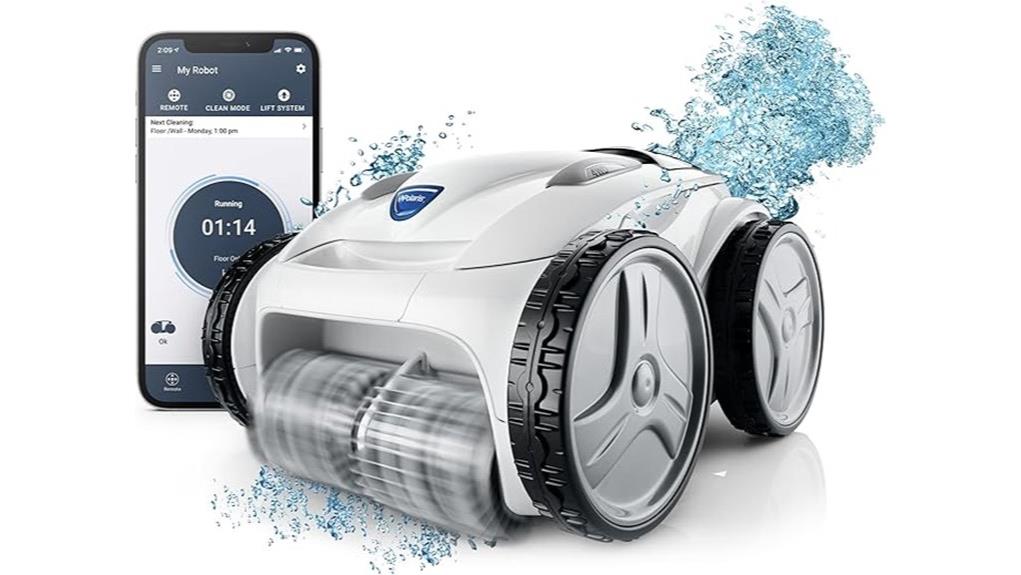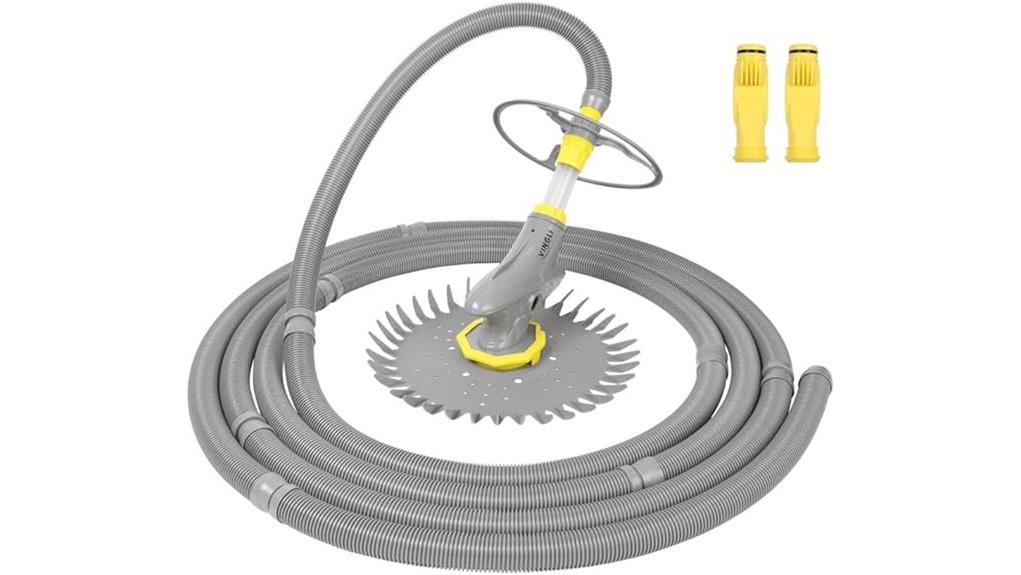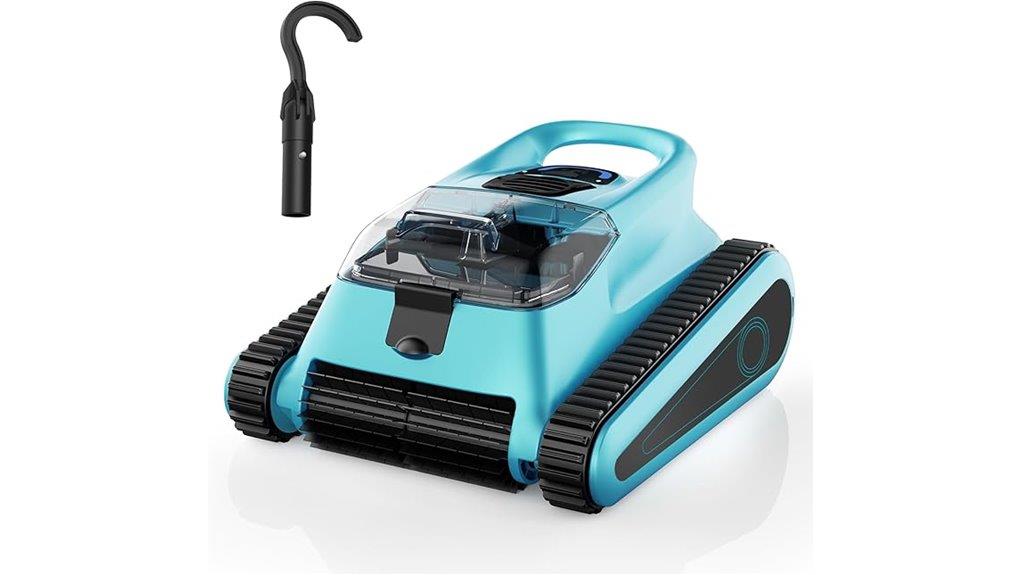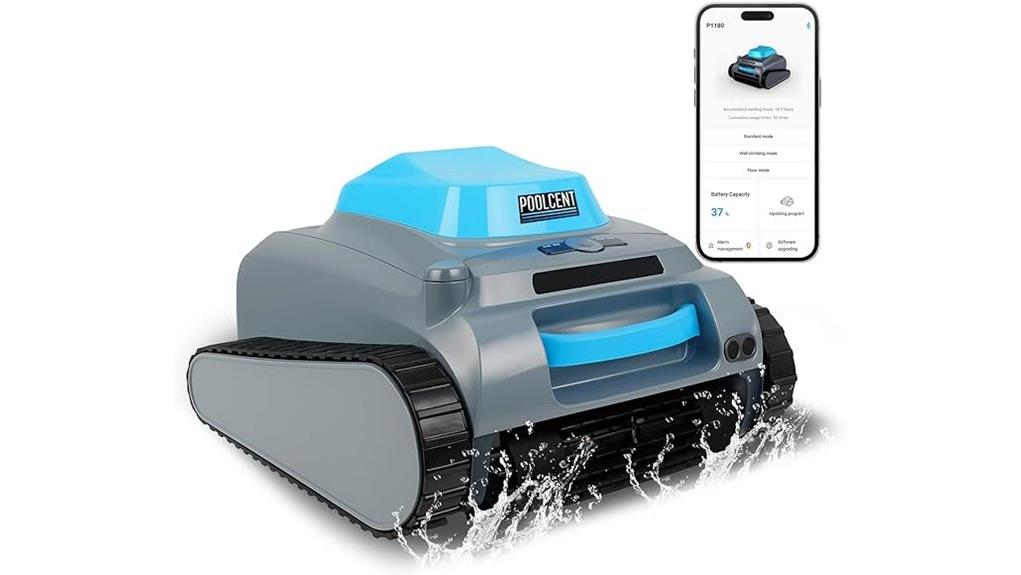
You’ll like the PoolCent PC1180 if you want cordless convenience for routine upkeep; it delivers strong 80 GPM suction, climbs walls with sonar-guided navigation, and handles floors and waterlines well for small-to-medium pools. Runtime tops out near two hours per 22.2V/4400mAh charge but dips with heavy debris or long climbs. Filters fill quickly and need regular rinsing, and it won’t replace professional deep-cleaning — keep going to see detailed performance, runtimes, and maintenance tips.
Some Key Takeaways
- Cordless PoolCent PC1180 offers drop-in convenience and up to about two hours runtime for routine pool maintenance.
- Strong suction rated at 80 GPM handles sand, fine debris, pet hair, and small-to-medium leaves effectively.
- 3-in-1 cleaning covers floor, walls (sonar-guided climbs), and waterline, though grout lines may need extra passes.
- Dual filters (70 µ and 150 µ) total ~4 L require frequent cleaning and reduce suction when clogged.
- Not a substitute for professional deep cleaning; battery aging, navigation hiccups, and heavy leaf loads limit performance.
Is the PoolCent PC1180 Worth Buying? Quick Verdict and Who It Suits
While it won’t replace a professional service for heavily soiled pools, the PoolCent PC1180 offers a compelling balance of cordless convenience, strong suction (80 GPM), and versatile 3‑in‑1 cleaning for floor, walls, and waterline—so it’s worth buying if you want an easy, low‑maintenance option for regular upkeep. You’ll get up to two hours runtime, smart sensor navigation, dual filters that trap fine debris, and app/Bluetooth control. It’s a sensible budget pick for small-to-medium pools, especially if you need compact storage and cordless drop-in use. You shouldn’t expect industrial-grade deep cleaning, but it delivers reliable routine maintenance.
What the PC1180 Cleans Well: Real-World Performance (Floor, Walls, Waterline)
How well does the PC1180 handle routine pool grime? You’ll find it strong on floors: 80 GPM suction and dual filters reliably clear sand, fine debris and pet hair from flat surfaces. Walls and tile grout benefit from the high-traction treads and sonar-guided climbs; grout lines need occasional passes but overall scrubbing is solid. Waterline scum and floating detritus get picked up during edge cycles, though heavy mats require manual removal first. Leaf pickup is dependable for small-to-medium leaves; large volumes slow cycles. In shallow pools its traction and coverage remain effective, provided debris isn’t piled deep.
Battery, Runtime, and Charging: How Long It Runs and What to Expect
Because the PC1180 runs on a 22.2V/4400mAh lithium‑ion pack, you can expect up to about two hours of cordless cleaning per charge, which covers most routine sessions for small-to-medium pools. You’ll get predictable runtime under normal conditions; heavier debris or long wall climbs reduce that. Charging time averages around 3–4 hours to full, so plan cycles accordingly. Power management is reasonable—built-in circuitry prevents overdischarge and supports consistent output during a run. Battery longevity looks typical for lithium cells if you avoid deep discharges and extreme temps. Consider buying replacement batteries if you need near-continuous operation.
Filtration, Suction, and Navigation: Tech Specs That Affect Cleaning Results
Although the PC1180’s specs sound promising on paper, you should focus on three measurable things that determine real-world cleaning: suction flow, filter capacity/mesh rating, and navigation accuracy. With a stated 80 GPM suction and dual filter media (70 µ + 150 µ) holding about 4 L, you can expect efficient leaf and sand capture but limited ultrafine filtration. Verify throughput under load—suction drops with clogged media. Sonar mapping and smart sensor navigation promise systematic coverage; measure missed spots and overlap. Combine measured suction retention, usable filter volume, and mapped-path accuracy to judge actual cleaning performance.
Maintenance, Common Issues, and Value: Costs, Warranty, and Final Recommendation
When you factor in routine upkeep, the PC1180 stays relatively inexpensive to own: filters need regular rinsing and occasional replacement, the dual 4 L cartridges will fill quickly in leafy pools, and battery health determines long-term runtime. Expect modest maintenance costs for replacement cartridges and eventual battery service; budget accordingly. Warranty terms are manufacturer-dependent, so check specifics for coverage length and battery exclusions. Common issues reported include reduced suction from clogged filters, occasional navigation hiccups, and shorter run times as batteries age. Troubleshooting tips: clean filters after each use, update firmware via Bluetooth, reset the unit, and contact support if problems persist.
Some Questions Answered
Can It Handle Saltwater Pools Without Corrosion Issues?
Yes — you can use it in saltwater pools, but check specifics: the unit’s plastic body and sealed lithium-ion pack resist corrosion, so saltwater compatibility is generally good. You should still monitor for electrode degradation in any exposed metal contacts and rinse connectors after heavy salt exposure. Follow manufacturer guidance, firmware updates, and warranty terms; regular inspections and freshwater rinses will minimize long-term corrosion risk and preserve performance.
Is It Safe for Vinyl and Fiberglass Pool Surfaces?
Yes — you can use it on vinyl and fiberglass surfaces. Its gentle suction and high-traction treads clean effectively without aggressive scrubbing, and dual-layer filters capture debris to prevent abrasive particles from rubbing surfaces. Smart navigation helps avoid repeated pressure spots. Based on specs (wall-climbing motor, soft treads, adjustable cleaning modes), surface compatibility looks strong, though you should still test a small area and follow manufacturer care recommendations.
How Loud Is the Cleaner During Operation?
You’ll find the cleaner reasonably quiet; it doesn’t distract during normal pool use. Measured noise level hasn’t been officially published, so a precise decibel rating isn’t available from the manufacturer. Based on cordless robotic norms and its lithium-ion motor, expect moderate sound comparable to household appliances (roughly 50–65 dB). If you need exact decibel rating for your setting, you’ll want to measure it with a sound meter during operation.
Are Replacement Parts Readily Available?
Yes — replacement parts are generally obtainable, but availability varies. You’ll find filter cartridges through the manufacturer and some retailers; they match the dual-filter system and specified micron ratings. Replacement motors are less common but available via PoolCent service or specialty suppliers; expect longer lead times and potential warranty routing. Check PoolCent support and authorized dealers first, and keep model/part number handy to guarantee compatibility.
Can Multiple Users Control It via the App Simultaneously?
Yes — you can have multi user control, but simultaneous access depends on the app. You’ll get app sync allowing multiple accounts to pair and perform remote control, though only one device session may actively control navigation at a time on some Bluetooth implementations. Check the app’s settings and firmware notes for explicit simultaneous access support; evidence shows many Bluetooth-controlled cleaners permit multi-account pairing but restrict concurrent command streams.