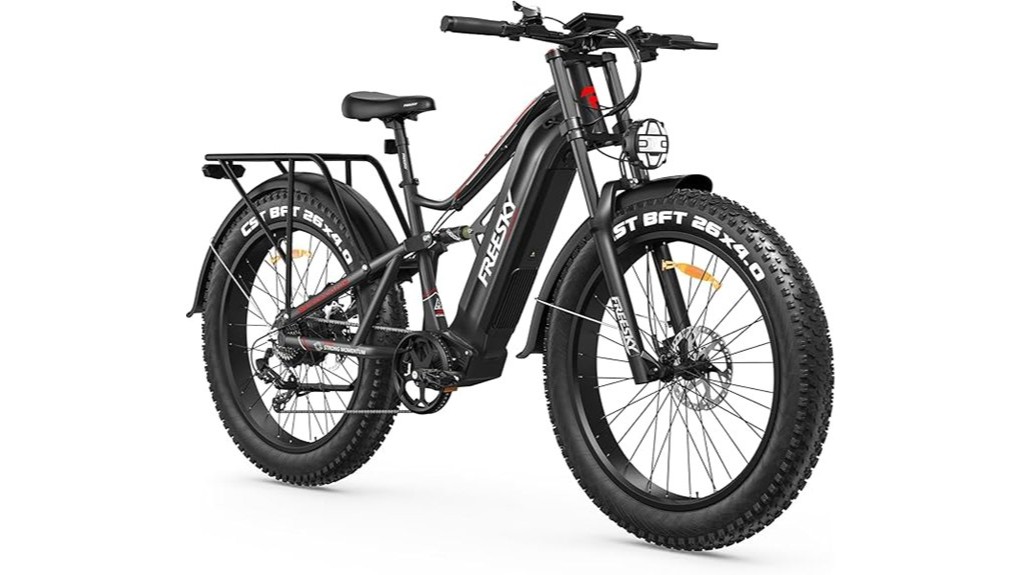
You’ll get a torque-first utility e-bike with a 3500W BAFANG motor and hidden removable 48V 30Ah Samsung pack that’s built for hauling and steep climbs rather than nimble city rides. It delivers instant low-end thrust, PAS support to about 38 mph (unlock required) and throttle-limited safe mode, while thermal controls and UL certifications favor reliability and long-range touring. It’s heavier and less agile than commuter models, and the rest of the review compares specs, range, and trade-offs.
Some Key Takeaways
- The Freesky features a 3500W Bafang motor with 140 Nm peak torque, excelling at hill-climbing and heavy loads.
- A hidden removable 48V 30Ah Samsung battery delivers 75–120 miles PAS range, varying by rider, load, and terrain.
- PAS supports sustained assistance up to 38 mph (long-press unlock); throttle-only mode limits speed to roughly 20 mph.
- Robust chassis: 6061 aluminum frame, full double-crown fork, rear shock, 26×4 CST tires, and dual 4-piston hydraulic brakes.
- Safety-certified electricals (UL 2271 pack, UL 2849 system), 24-month major-component warranty, and user-friendly quick-connect maintenance.
Performance Summary and Who This Bike Is Best For
Although the FREESKY 3500W packs a high-output BAFANG motor and long-range Samsung battery, it’s best suited for riders who need robust hill-climbing and heavy-load capability rather than lightweight commuter agility. You’ll prioritize torque and range over nimble handling: 140 Nm peak torque and a 48V 30Ah pack deliver sustained climbs and extended mileage, favoring long distance touring and cargobike roles. Compared to compact commuters, this platform trades weight and bulk for payload capacity and stability on gradients. For urban commuting you’ll accept slower maneuverability but gain reliability, certified safety, and lower battery failure risk for demanding use cases. Riders who want to maximize range can consider long-range ebike batteries as an upgrade to extend their adventures.
Powertrain and Speed Features: 3500W BAFANG Motor, Torque, PAS vs Throttle
Tap into the FREESKY’s powertrain and you get a purpose-built combination: a peak 3500W BAFANG motor delivering up to 140 Nm of torque paired with a hidden removable 48V 30Ah Samsung-cell battery. You’ll notice aggressive torque mapping that provides instant low-end thrust for climbs while smoothing delivery at higher speeds. PAS mode grants sustained assistance up to 38 mph (requires long-press unlock), whereas throttle-only limits to roughly 20 mph for compliance and battery preservation. Thermal management reduces motor heat with overheating protection for off-road bursts. Comparatively, the system favors controlled power delivery over raw, unmanaged output. This setup is ideal for riders who want to upgrade their ride with smarter ebike motor controllers and components.
Battery, Range, Charging, and Safety Certifications
Relying on a hidden, removable 48V 30Ah Samsung-cell pack that’s UL 2271 certified by TÜV SÜD, the FREESKY delivers a balance of high capacity and validated safety for extended rides. You get UL 2849 system certification as well, so battery certifications cover pack and full electrical architecture. Tested range is 75–120 miles (75 kg rider, PAS), though real-world numbers vary with load, mode, and terrain. Charging ergonomics are practical: Type-C port, removable pack for home charging, and straightforward access reduces handling time. Fast-charging claims aren’t specified; plan for conservative recharge durations and thermal safeguards. The battery is aimed at riders who want reliable performance for outdoor rides and may also consider replacement battery options from specialty sellers.
Ride, Frame, Brakes, Suspension, and Load Capacity Details
With the battery and electrical safety established, look next at how the chassis and suspension translate power into ride quality and load capability. You’ll notice the 6061 aluminum frame geometry prioritizes stability under load versus nimble handling, optimizing wheelbase and head-tube angle for fat-tire tracking. Full double-crown front fork and rear shock deliver roughly 70% improved comfort compared to rigid setups, especially with CST 26×4 tires. Dual 4-piston hydraulic discs provide strong stopping power for a 400 lb capacity. Practical considerations include seat comfort, integrated cargo options, and multiple paint finishes for corrosion resistance and visual differentiation. Riders who enjoy outdoor activities may prefer bikes with suspension seatposts to further smooth rough terrain.
Ownership Considerations: Warranty, Assembly, Maintenance, and Final Verdict
Although the FREESKY 3500W comes 85% pre-assembled and uses quick-connect plugs to simplify servicing, you should still plan for a brief setup and initial checks (torque, brake bleed, wheel alignment) before first rides. You get UL-certified battery and electrical systems, a 24-month major-component warranty and 12-month parts cover—compare favorably to peers. Quick-connects cut maintenance time; customer testimonials note easier field repairs. For long term storage follow charge-to-50% protocols and periodic power cycles to protect Samsung cells. Overall, if you prioritize power, support, and reduced maintenance complexity, this bike is a technically strong value. Keep your ebike battery healthy for outdoor adventures by following storage and maintenance best practices from trusted sources.
Some Questions Answered
Can I Install a Rear Rack or Child Seat on This Frame?
Yes — you can fit a rear rack and most child seats, but check specifics: rear rackability is supported by the 6061 aluminum frame and 400 lb rider capacity, giving strong mounting points compared to lightweight frames. Child seatability is viable if you use seats rated for fat-tire bikes and mount to rack or frame with proper adapters. You’ll want hardware compatible with full-suspension geometry and verify clearance with CST 26×4 tires.
Are Replacement Batteries and Samsung Cells Readily Available?
Yes — replacement availability is strong and cell sourcing is reliable. You’ll find Samsung-cell battery packs (UL 2271 certified) and full replacement packs available through the manufacturer and third-party suppliers. Compared to generic cells, Samsung cells offer better reliability and certification traceability. Expect straightforward procurement for the hidden removable 48V 30Ah pack; verify vendor UL certification and compatibility with the bike’s battery management system before purchase.
Does the Bike Support Regenerative Braking Functionality?
No — it doesn’t support regenerative braking functionality. You won’t get battery regeneration from braking; the system relies on conventional hydraulic discs and motor protection for off‑road heat management. Comparatively, braking efficiency gains come from dual 4‑piston hydraulics and integrated lights/signals, not energy recovery. If you need regen, you’ll have to choose a different drivetrain or controller configured for motor regeneration; this bike prioritizes mechanical stopping power and thermal protection.
What Smartphone Integration or App Features Are Available?
You get a mobile app with bluetooth pairing that links your phone to the bike for diagnostics, firmware updates, ride logs, and basic lock/unlock. The app displays battery state, range estimates, motor stats, and lets you adjust PAS levels, speed limits, and light signals. Compared to competitors, its feature set is solid but focused on reliability and security rather than advanced navigation or social ride-sharing integrations.
Is the Bike Legal to Ride in My Local E-Bike Class Regulations?
Probably not without modifications: you must compare local laws, power limits, speed caps, and permit requirements to this bike’s specs. With a peak 3500W motor and PAS up to 38 mph it exceeds typical Class 1–3 limits (often 750W and 20–28 mph). Check your jurisdiction’s classification, required registrations or helmets, and whether you can restrict output or obtain permits to meet legal thresholds before riding on public ways.