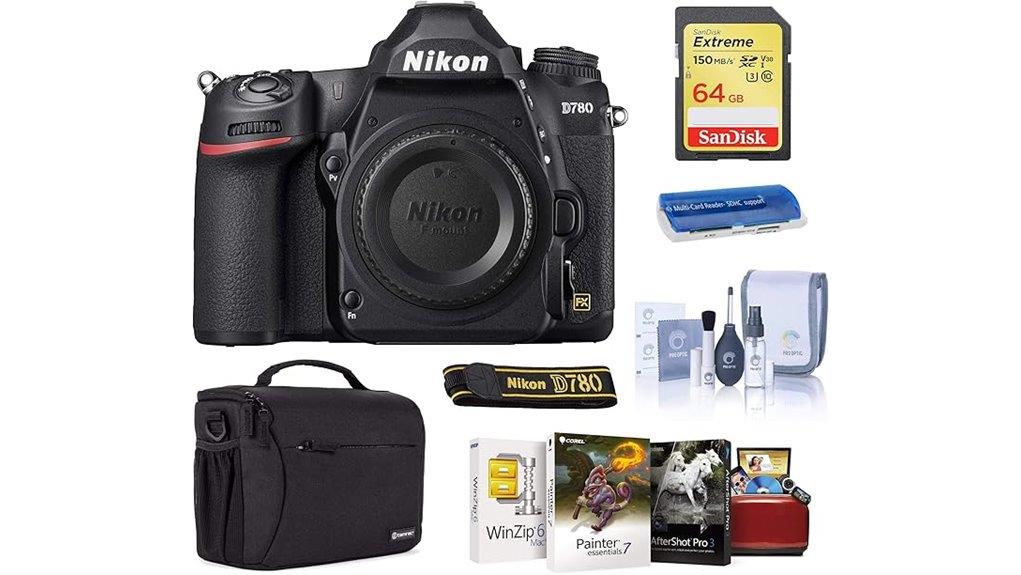
The Nikon D780 gives you a confident hybrid DSLR: a 24.5MP full‑frame sensor, true 4K UHD from the full sensor, and a refined grip that aids handheld shooting. You’ll get clean, detailed images to about ISO 6400 and usable results well beyond with careful processing. Autofocus is competent with a Hybrid AF option in Live View and 7 fps bursts for steady action. Battery life and connectivity are strong, and scrolling on will explain recommended bundles and real‑world limits.
Some Key Takeaways
- 24.5MP full‑frame sensor delivers clean, detailed images with strong dynamic range and usable high‑ISO performance up to ISO 51,200.
- 7 fps mechanical burst and reliable optical‑viewfinder AF make it effective for action and event shooting with proper buffer and cards.
- Hybrid on‑sensor phase‑detect AF in Live View provides improved tracking and fast focus for stills and video compared with older DSLRs.
- True full‑width 4K UHD video (30/25/24p) offers high detail, but rolling shutter and limited in‑body stabilization are drawbacks.
- Excellent ergonomics, long battery life, and DSLR accessory compatibility make it a strong hybrid option for travel, portraits, and low‑light work.
What the Nikon D780 Offers at a Glance
Explore the Nikon D780 and you’ll find a versatile FX-format DSLR that balances high image quality with modern features: a 24.5‑megapixel sensor, 7 fps continuous shooting, and native ISO 100–51,200 (expandable to 204,800) for wide-ranging low‑light performance. You’ll notice ergonomic improvements over predecessors: a refined grip and better button placement that aid handheld stability. Menu navigation is cleaner, though some functions remain buried under submenus. Battery life impresses for long shoots, reducing swap frequency. Optical viewfinder comfort is strong—bright, clear, and well-placed—yet heavier bodies may fatigue you on extended assignments despite the improved ergonomics. For enthusiasts looking to outfit their camera, essential DSLR accessories like straps, bags, and lens filters can enhance shooting comfort and protection.
Image Quality and Low‑Light Performance (24.5MP, ISO up to 204,800)
Delivers clean, detailed images across a wide range of conditions, the D780’s 24.5‑megapixel FX sensor strikes a strong balance between resolution and noise control—fine detail and tonal gradation hold up well up to about ISO 6400, and usable results extend into the 12,800–25,600 range with careful processing. You’ll appreciate the camera’s dynamic tonal rendering in highlights and midtones, preserving scene contrast without harsh clipping. Expect restrained chroma noise and preserved edges, though high iso texture softens gradually and requires selective sharpening. Shadows lift well with modest noise increase; push much beyond 51,200 and artifacts become intrusive. The body’s controls and accessory ecosystem make it popular among enthusiast photographers who want to expand their kit.
Autofocus, Speed, and Shooting Experience (7 Fps, AF Behavior)
Having seen how the D780 handles noise and tonal detail, you’ll notice its autofocus and burst capabilities shape how reliably you capture those moments. You get 7 fps mechanical continuous shooting, which is steady for a DSLR but not blistering; buffer depth and write speeds matter, so use fast cards. The hybrid AF system relies on on-sensor phase detection in Live View for snappy, accurate focusing and improved tracking compared with older Nikon DSLRs. Focus acquisition with the viewfinder is competent. The joystick control makes selecting AF points quick, though customizable AF-C behavior can require tuning for erratic subjects. Consider pairing the camera with a sturdy tripod head for smoother compositions and steady framing when using slower shutter speeds or long lenses, especially a model known for unified support.
Video Capability and Hybrid Workflow (4K UHD at 30/25/24p + Connectivity)
When you switch into video mode, the D780 gives you true 4K UHD (3840 x 2160) at 30/25/24p using the full sensor width, which means you get higher-resolution footage without a heavy crop and better use of your lenses. You’ll appreciate clean detail from the 24.5MP sensor and reliable exposure, but note rolling shutter and limited in-body stabilization compared with mirrorless rivals. Dual-purpose shooters will like straightforward 4K workflows and full-HD slow‑motion options. Connectivity is practical: built-in Wi‑Fi and Bluetooth enable rapid Wireless transfer to devices for preview and tagging, though large-file handling still favors card readers. For photographers concerned about preserving and accessing footage long-term, consider secure cloud storage for photo backups and easy sharing.
Who Should Buy the D780 and Which Bundle to Pick (Use Cases, Accessories Included)
If you shoot both stills and video and want a robust DSLR that balances image quality, battery life, and traditional handling, the D780 is a strong choice—especially for hybrid shooters who value the full-sensor 4K, reliable autofocus in live view, and 7 fps burst for run-and-gun work. You should buy it if you do travel photography and portrait sessions, need excellent low-light performance at ISO up to 51,200 (expandable), and prefer optical viewfinder workflow. Pick the bundle with case, 64GB SD card, cleaning kit, card reader and Mac software pack to start shooting immediately and protect gear. It also pairs exceptionally well with a dedicated camera backpack designed for photographers to carry and protect lenses, bodies, and accessories on the go.
Some Questions Answered
Does the D780 Have In-Body Image Stabilization (IBIS)?
No, it doesn’t have in-body image stabilization. You’ll rely on lens stabilization or faster shutter speeds to control blur, especially in low light despite the high ISO range. You’ll appreciate the effective sensor cleaning system for dust management when changing lenses frequently, but don’t expect sensor-shift stabilization. If you need IBIS, you’ll want a different body or stabilized lenses; weigh lens costs against the convenience of built-in stabilization.
What Battery Model Does the Camera Use and How Long Does It Last?
The D780 uses the EN-EL15 series battery (commonly EN-EL15a/b). You’ll get about 2,230 shots per CIPA battery life in viewfinder use, more in live view/4K video it drops substantially. You’ll want spare packs for long shoots; two or three is typical. You can charge batteries in-camera via USB with compatible chargers or use an external AC charger or dedicated multi-bay charger for faster turnaround. Monitor temps and capacity.
Is Dual Memory Card Slot Support Available?
No — the camera doesn’t offer dual memory card slot support. You’ll want to dismiss Dual slot rumors and plan your Workflow implications accordingly: rely on a single SD slot, back up frequently to your included 64GB card and external drives, or use tethering and Wi‑Fi/Bluetooth transfers. Be critical about redundancy — invest in fast, high‑capacity cards, a reliable card reader, and a disciplined backup routine to avoid data loss during shoots.
Can the D780 Capture Full-Frame 120FPS Slow-Motion Internally?
No — the D780 can’t record internal full-frame 120fps. You’ll run into 120fps limitations because the sensor readout and internal processing don’t support full-frame 120p capture; 4K tops out at 30/25/24p and high‑speed capture requires crop or external recorder solutions. If you need 120fps, you’ll have to accept a sensor crop, lower resolution, or use an external device that can handle the faster sensor readout.
Does It Support UHS-II Speeds for Faster Card Performance?
No — the D780 doesn’t offer full UHS II compatibility in both slots; it supports UHS-II card read/write speeds only in the single XQD/CFexpress-equivalent slot? Actually, the D780 uses one UHS-II capable SD slot and one slower UHS-I slot, so you’ll only get maximum Card write speed when using the UHS II-compatible slot. You should use a high-quality UHS II card to avoid bottlenecks during high-bitrate video or burst shooting.