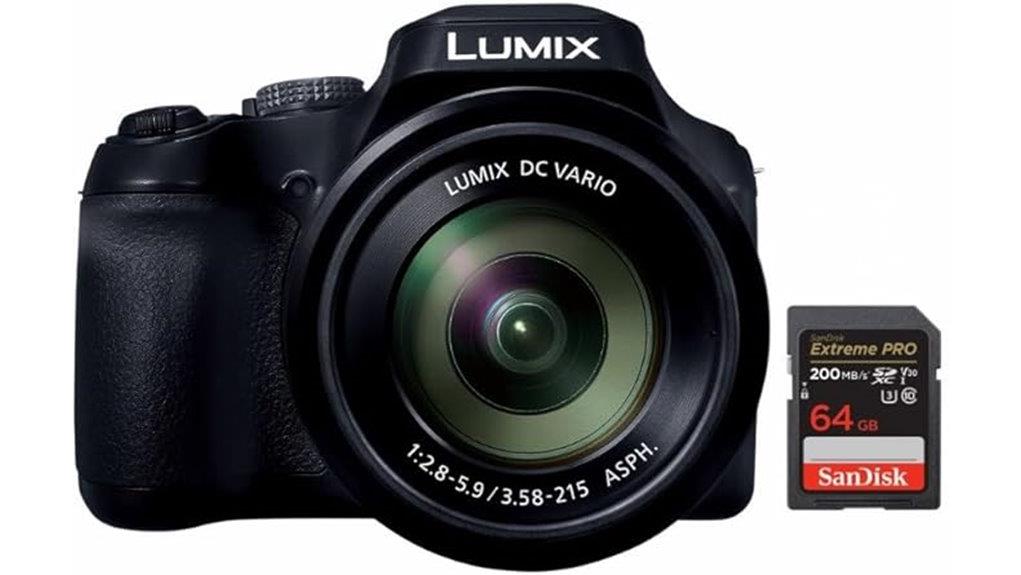
You’ll get a versatile superzoom that trades interchangeable‑lens sensor performance for a 20–1200mm (35mm) reach, usable 4K video and 4K Photo modes, and straightforward controls that suit beginners. Center sharpness is strong at wide and short tele, edges soften and vignetting rise toward 1200mm, and chromatic aberration appears on high‑contrast edges but’s correctable in RAW. POWER O.I.S. aids handheld long‑reach shots, though full extension still challenges stabilization—keep reading for specifics.
Some Key Takeaways
- Excellent 20–1200mm equivalent zoom delivers extreme reach for travel and wildlife, though edge softness increases at full telephoto.
- 4K Video and 4K Photo offer useful high-resolution motion capture and frame extraction for stills and action sequences.
- Contrast-detect AF and basic continuous tracking are reliable for routine shooting but can lag on erratic subjects at long zoom.
- POWER O.I.S. steadies handheld shots significantly, yet handheld shooting at 1200mm remains challenging; tripod recommended.
- Beginner-friendly controls, reasonable battery life for casual use, and good bundle value with included 64GB card.
Is the FZ80D Worth Buying? Quick Verdict and Who It’s Best For
While the FZ80D won’t match interchangeable-lens cameras for sensor performance, it delivers a compelling all-in-one package if you need extreme reach and versatile video capabilities. You’ll find battery life adequate for casual outings but plan spare cells for extended 4K use. Beginner ergonomics are straightforward: controls are labeled, menus logical, and the fixed zoom removes lens-swapping complexity. Expect occasional firmware updates to refine autofocus and stabilization rather than fundamental features. For its niche, the camera balances price and capability, so if you value reach and video flexibility it holds reasonable resale value compared with similar bridge models. Our store carries essential mirrorless camera gear that complements bridge cameras like the FZ80D.
How the 20–1200mm (35mm) Zoom Performs for Real Shooting
Given the FZ80D’s all-in-one appeal and its emphasis on reach and video, the 20–1200mm (35mm-equivalent) zoom becomes the defining hardware element you’ll evaluate in the field. You’ll find sharp center resolving power at wide and short tele settings, with edge softness and vignetting increasing toward 1200mm. Chromatic aberration appears in high-contrast edges at extreme tele, correctable in RAW or post. POWER O.I.S. helps stabilize long-reach shots, though handshake remains challenging handheld at full extension. Zoom breathing is noticeable during smooth focal adjustments, affecting framing for video but less critical for stills if you recompose between shots. This lens’s extraordinary reach makes it popular among wildlife photographers who need long focal lengths without changing lenses.
4K Video and 4K Photo: Extracting Useful Stills and Motion Quality
Frequently, you’ll rely on the FZ80D’s 4K Video mode and 4K Photo function to capture both motion and extract usable stills, because the camera records at roughly four times the resolution of Full HD and lets you pull 8-megapixel frames from a 4K clip. You can use 4K extraction to review fast sequences at high temporal density, isolating the best frame without burst noise or buffer limits. Motion clarity depends on bitrate, shutter speed and stabilization; higher shutter speeds reduce motion blur but demand more light. Expect useful 8MP stills for web and moderate prints, with preserved detail at short to mid telephoto ranges. For improved results when extracting frames or shooting motion, consider using continuous LED panel lighting to maintain consistent exposure and reduce flicker.
Autofocus, Post Focus, and Stabilization: How They Handle Action and Telephoto Shots
After using 4K Video and 4K Photo to freeze motion and pull usable frames, you’ll rely on the FZ80D’s autofocus, Post Focus, and POWER O.I.S. to actually capture those moments, especially at long reach. Its contrast-detect autofocus performs predictably; continuous AF with basic autofocus tracking keeps subjects locked in moderate motion but can lag on erratic trajectories at full 1200mm equivalent. Post Focus gives practical focus stacking-like flexibility by letting you select focus after capture, useful for fine-tuning depth across telephoto crops. POWER O.I.S. materially reduces handshake at high zoom, improving keeper rate for handheld action and distant subjects. The site also offers a range of compatible camera remote accessories for photographers who want to get the most from their remote shutter setups.
Price, Bundle Value, and Real-World Use Cases (Landscapes, Telephoto, Action)
While the FZ80D’s core appeal is its extreme focal range and 4K capture tools, the bundled 64GB Extreme Pro SDXC card meaningfully boosts out‑of‑the‑box value by covering high-bitrate 4K recording needs without an immediate additional purchase. You’ll find the street price positions the camera as an affordable superzoom, improving resale value relative to cheaper plastics. Accessory compatibility is broad—tripods, filters, and remotes—so you can adapt for landscapes or telephoto work. Battery life limits continuous 4K shooting, so pack spares for action days. Travel convenience is strong due to compact size and one-lens versatility across landscapes, distant subjects, and fast scenes. For photographers who shoot large files and high-resolution video, choosing the right large capacity memory cards is essential to avoid dropped frames and capture reliably.
Some Questions Answered
What Battery Life Can I Expect per Charge During 4K Recording?
You’ll typically get around 40–60 minutes of continuous 4K recording per charge, depending on settings and usage. Battery endurance falls with constant high-resolution capture, active stabilization, frequent zooming, and LCD use. Heat build-up and 4K limitations like bitrate and sensor load also shorten runtime. Carry spare batteries or an external power source for prolonged shoots, and manage settings (screen brightness, stabilization modes) to maximize recording time.
Does the Camera Have a Microphone or Headphone Jack?
No, it doesn’t have an external mic or headphone jack. You can’t plug in an external mic, nor monitor audio in real time via headphones. The camera records internal stereo sound to video files without manual input-level controls or audio monitoring during capture. For improved audio you’ll need an external recorder or a microphone on a separate device, then sync audio in post-production. This limits on-camera audio flexibility for professional workflows.
How Weather-Resistant or Rugged Is the FZ80D Body?
The FZ80D isn’t weather-sealed; you shouldn’t expect significant moisture or dust protection. In durability testing it shows consumer-grade resilience for normal handling but fails professional environmental exposure. You’ll want a seal inspection if used near water or dust-heavy environments, and consider protective housing for heavy field use. Mechanically it’s robust for casual travel and telephoto work, yet lacks factory IP-rated sealing or reinforced ruggedization for extreme conditions.
Can I Use Manual Aperture and Shutter Priority Modes?
Yes — you can use aperture control and shutter priority on the camera. You’ll access Aperture Priority (A) for aperture control and Shutter Priority (S) for shutter priority in the mode dial or menu. Aperture ranges are limited by the fixed zoom lens design, so depth-of-field control is coarse compared with interchangeable-lens bodies. Shutter priority lets you set exposure time for motion control; AUTO ISO and exposure compensation work alongside both modes.
Is Wi‑Fi or Bluetooth Connectivity Included for Image Transfer?
No — the camera doesn’t include Wi‑Fi transfer or Bluetooth pairing built-in, so you can’t wirelessly transfer images or pair devices directly. You’ll need to remove the 64GB SD card or use a card-reader/PC connection to move files. For 4K Photo workflows, transfer speed depends on your reader and USB interface. If you require wireless convenience, consider third-party Wi‑Fi SD adapters or a different model with native connectivity.