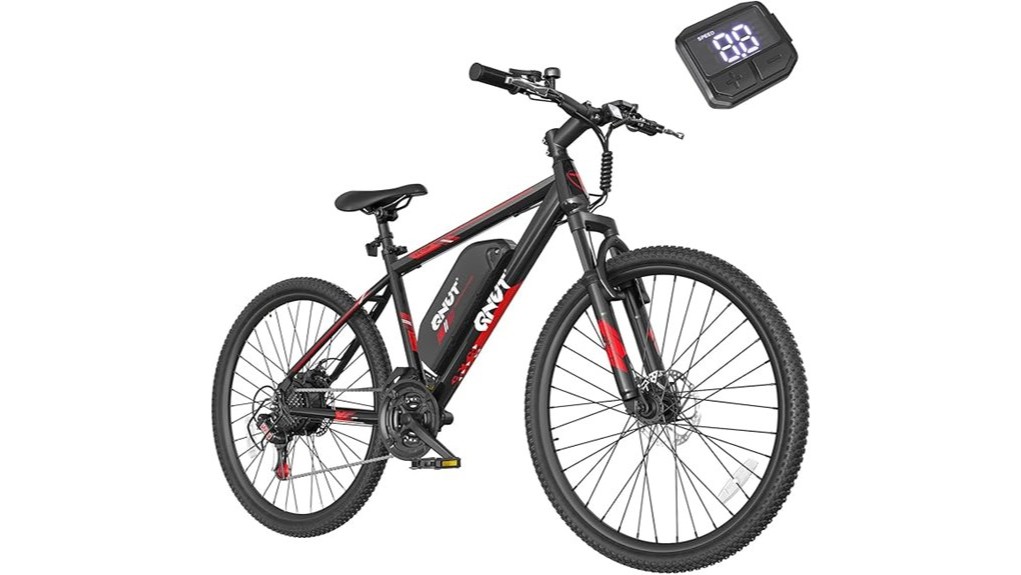
You’ll find the QNUT Peak 1000W is a rugged, torque‑heavy commuter e‑bike that’s built for fast urban runs and light trails. Its 1000W peak motor and 21‑speed Shimano‑style drivetrain give brisk acceleration, usable hill-climb up to ~15° with pedal input, and a throttle for short independent rides. The 36V 10.4Ah removable battery delivers about 20–35 miles real‑world, charges in 4–6 hours, and the steel frame plus mechanical discs prioritize durability and predictable stops — keep going to see full specs and maintenance notes.
Some Key Takeaways
- Peak 1000W brushless motor provides strong low‑end torque and supports cruising up to about 28 MPH in PAS mode.
- 36V 10.4Ah (375Wh) removable battery claims up to 45 miles but realistically delivers 20–35 miles depending on conditions.
- Shimano‑style 21‑speed drivetrain with cadence sensing and throttle aids climbing to roughly 15° with rider input and correct gearing.
- Sturdy 26″ steel frame, front suspension, and mechanical disc brakes offer durable, predictable handling and reliable stopping power.
- Ships 90% assembled with a 12‑month warranty; routine maintenance is low but extended warranty recommended for heavy or cargo use.
Quick Verdict: Who Should Buy the QNUT Peak 1000W Ebike
If you need a robust commuter or light‑trail e‑bike that balances power and practicality, the QNUT Peak 1000W is worth considering: its 1000W brushless motor and 36V/375Wh removable battery deliver up to 28 MPH in PAS and as much as 45 miles per charge, while a 21‑speed drivetrain, front suspension, and mechanical disc brakes handle varied terrain and loads up to 308 lbs. You’ll find it suited for urban commuters who need reliable speed, range, and durability and for cargo riders requiring higher payload capacity. It’s technical, rugged, and practical for mixed-use commuting and light hauling. Trail e-bike riders will appreciate accessories and gear tailored to outdoor adventure needs.
Power and Climbing: Motor, Speeds, and Hill Performance
Building on its suitability for urban commutes and light hauling, the Peak’s propulsion package centers on a peak 1000W brushless motor that delivers strong low‑end torque for quick starts and sustained cruising up to 28 MPH in PAS mode. You’ll notice high torque output that assists launches and keeps speed on flat sections. The Shimano-style 21-speed gearset pairs with cadence sensing to optimize pedal assist and maintain efficient motor load. Throttle offers short independent range, while documented climbs to about 15° are manageable with rider input and correct gearing. Performance is predictable and mechanically robust. Riders seeking more intense off-road capability may consider pairing the Peak with high-performance ebike motors for outdoor activities to maximize torque and durability.
Range, Battery Life, and Charging in Real-World Use
Typically, you’ll get up to about 45 miles on a single charge in PAS mode from the Peak’s 36V 10.4Ah (375Wh) removable lithium battery. In real-world mixed riding expect 20–35 miles dependent on assist level, payload, gradient, and wind. Recharge time is 4–6 hours using the supplied UL2849-compliant charger; you can remove the pack for indoor charging. To minimize battery degradation, avoid full discharges, store at ~50% for long periods, and keep temperature moderate. Charging etiquette: use the manufacturer charger, avoid continuous trickle charging, and don’t charge unattended in extreme heat or cold. For outdoor riders, consider choosing replacement packs with UL certification and rugged casings for safer, more reliable performance.
Ride Comfort, Build Quality, and Braking Safety
Although the Peak’s 26″ steel frame and front suspension fork prioritize durability and vibration damping, you’ll notice ride comfort varies with tire pressure, rider weight, and terrain. You get predictable handling from a stiff frame and stable geometry; vibration damping from the fork and frame helps on rough surfaces but won’t replace wider tires or suspension travel. Seat ergonomics are adequate for short to medium rides; adjust saddle height and fore-aft position to reduce pressure points. Mechanical disc brakes deliver consistent stopping power and modulation; regular pad inspection and cable tension checks maintain braking safety. Build quality is robust, with welds and components meeting expected tolerances. Consider upgrading to an ebike suspension seatpost for improved comfort on longer rides and rougher trails, as suspension seat posts can significantly reduce rider fatigue.
Ownership Costs, Warranty, Assembly, and Final Recommendation
Now that you’ve seen how the Peak handles and stops, let’s look at what owning one actually costs and how it’s supported. Expect low routine maintenance costs: brake pads, tires, chain lube, and occasional tune-ups given the steel frame and mechanical discs. The included 12-month warranty covers major defects; consider an extended warranty if you plan heavy use or higher mileage. It ships 90% assembled—follow assembly tips: torque headset, align wheels, check brake pads, and secure battery. Customer support offers lifetime 1-on-1 help with ~24-hour response. Recommendation: solid value for commuters needing torque and range. Gear up with the right ebike maintenance gear to keep your Peak reliable on outdoor rides.
Some Questions Answered
Is the Battery Removable for Airline Travel and Carry-On Restrictions?
Yes — the removable battery can be taken out, but airline restrictions apply. You’ve got a 36V 10.4Ah (375Wh) removable battery, which exceeds many airlines’ typical 100Wh carry-on limit. You’ll need airline approval and possibly special handling or hazardous-goods procedures. Contact your carrier before travel, carry the battery in the cabin if permitted, protect terminals, and bring manufacturer documentation and UL 2849 certification to smooth approval.
Can I Use a Child Seat or Attach a Rear Rack?
Yes — you can fit a child seat or attach a rear rack, but you’ll need to verify mounting points and weight limits. The 26″ steel frame supports up to 140 kg; confirm combined rider, child, and accessory weight within that limit. Use a rack rated for the frame and for e-bike use, and choose a child seat compatible with mechanical disc brake clearance and the rear fender. Have a pro install to guarantee safety.
Is the Bike Compatible With Panniers or Standard Bike Locks?
Yes — you can fit panniers and use standard locks. The steel 26″ frame supports rear rackability; you’ll mount a rack either to existing frame mounts or seatpost-compatible hardware. Pannier compatibility is good with most standard pannier hooks and straps given the rack and 140 kg capacity. For security you’ll use U-locks or heavy chain locks around the frame and wheel; attach locks to sturdy points to prevent theft.
Does It Support Regenerative Braking or a USB Charging Port?
No — it doesn’t feature a regenerative system, and there’s no built-in usb port for device charging. You’ll rely on the 36V removable battery and standard controller for power management; charging is handled via the included indoor charger (4–6 hours). For devices, you’ll need an aftermarket USB adapter wired to the battery or a handlebar power bank. The bike’s electrical design prioritizes UL 2849 compliance and basic ride functions.
Are Replacement Tires and Brake Pads Readily Available?
Yes — you can source replacement tires and brake pads readily. Tire sourcing is straightforward: the 26″ steel frame uses common 26×1.95–2.1 tires available from major retailers. Pad compatibility is standard: mechanical disc brake pads follow common post/PM layouts, so aftermarket organic or sintered pads fit. You’ll want to verify rotor size and mount type before ordering, but overall parts availability and interchangeability are high for maintenance.