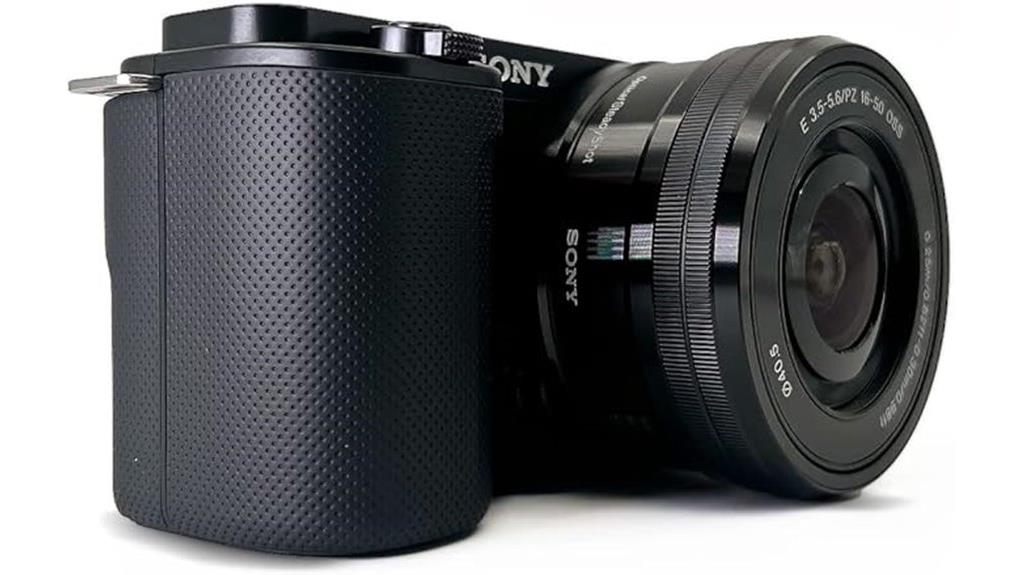
You’ll get a compact, grab‑and‑go APS‑C kit that’s tuned for creators: a 24.2MP ZV‑E10 body with a 16–50mm power zoom, USB single‑cable streaming, and creator tools like Product Showcase and Background Defocus. Video benefits from a 6K‑oversample‑to‑4K pipeline and fast phase‑detect AF with Eye AF, though there’s no IBIS and battery life is modest. It’s ideal for vloggers and streamers who value portability and simple workflows — keep going and you’ll find practical pros, cons, and pairing tips.
Some Key Takeaways
- 24.2MP APS-C sensor and 6K oversample-to-4K pipeline deliver sharp, low-noise 4K video with strong detail retention.
- Fast phase-detect AF with Eye AF and Product Showcase ensures reliable subject and object tracking for vlogs and reviews.
- Compact, lightweight body with touchscreen and side mic jack is ideal for handheld vlogging and quick setups.
- No in-body stabilization; electronic stabilization crops image and may judder, so consider gimbals or stabilized lenses for motion.
- USB plug-and-play streaming and power-zoom control simplify live workflows, but battery life and telephoto reach are limited.
What the ZV-E10 Power Zoom Kit Includes and Who It’s For
When you buy the ZV-E10 Power Zoom Kit, you get the 24.2MP APS-C ZV-E10 body paired with Sony’s compact 16–50mm power zoom lens, plus the usual essentials—battery, charger, USB cable for easy live streaming, strap and basic documentation. You’ll appreciate the included accessories that make setup and streaming immediate: the USB single-cable streaming workflow and power zoom control reduce gear complexity. Target creators who vlog, product-review, or stream will like the lightweight, interchangeable-lens flexibility and gadget-friendly features like Product Showcase and Background Defocus. It’s a pragmatic kit—portable, creator-focused, and optimized for quick-production workflows. Many mirrorless photographers also invest in essential gear to get the most from a kit like this.
Key Imaging and Video Specs That Matter (24.2MP APS-C, 4K Oversampled From 6K)
Because Sony pairs a 24.2MP APS-C Exmor sensor with BIONZ X processing and a 6K oversample-to-4K pipeline, you get sharper, cleaner 4K footage with reduced moiré and better fine-detail rendering than a native 4K read would typically deliver. That architecture preserves high resolution detail for both stills and video, delivering cleaner edges and more usable detail in grading. Full-pixel readout without binning avoids artifacts and preserves dynamic range. In practice, Oversampling benefits show in cleaner chroma, less noise at elevated ISOs, and greater flexibility for cropping or stabilization without visible quality loss. This makes the kit particularly appealing for DSLR enthusiasts looking for versatile hybrid imaging and video performance.
Autofocus, Subject Control, and Creator-Friendly Features in Practice
Sharper 4K and clean detail only matter if the camera can keep subjects confidently in focus, and the ZV-E10’s autofocus system is built to do exactly that. You get fast phase-detect AF, reliable face tracking and Eye AF that locks onto people even when you move. The Product Showcase setting smartly shifts focus to objects without manual fiddling; the Background Defocus button delivers instant creative bokeh for that cinematic separation. Touch control on the rear screen makes focus swaps intuitive, and the mic/ambient sound options guarantee clean audio capture for creators. For vloggers and interviewers, pairing the camera with purpose-built external mics can significantly improve recorded audio quality, especially in noisy environments with competing sounds like wind and traffic, making it easier to achieve professional results with the ZV-E10 and dedicated camera microphones.
Handling, Stabilization, Battery Life, and Live‑Streaming Experience
Although compact and lightweight, the ZV‑E10 feels purpose-built for run‑and‑gun creators, with a grippy body, intuitive rear touchscreen controls, and a side-mounted mic jack that keeps your workflow uncluttered. You get comfortable handling for handheld vlogging and quick framing, and the power-zoom lens balances well for smooth pans. Don’t expect in-body stabilization — electronic stabilization helps for casual work but crops and can introduce judder with pronounced motion. Battery drain is the tradeoff: long shoots or streaming sessions chew power, so carry spares or an external supply. Live streaming is delightfully simple via USB, plug-and-play without extra software. Check our guide to perfect tripods to pair the ZV‑E10 with stable, travel-friendly support for better handheld alternatives.
Verdict: Real-World Pros, Cons, and Buy Recommendation by Use Case
Having covered handling, stabilization, battery life and streaming, let’s judge how the ZV‑E10 performs day-to-day and who should buy it. You’ll get sharp 4K from a 24.2MP APS‑C sensor and smart AF for portrait vlogging; the Power Zoom 16–50mm keeps framing easy. Pros: excellent subject tracking, product‑showcase control, simple USB streaming and compact kit feel — travel ready. Cons: no in‑body stabilization, battery life modest, lens limited at longer focal lengths. Recommendation: buy if you’re a content creator prioritizing portability, livestreaming, and studio/handheld vlogs; consider alternatives if you need long reach or IBIS. For carrying and protecting this compact kit on shoots, choose a camera bag designed for photographers with padded compartments and quick access camera bag features.
Some Questions Answered
Does the Camera Have In-Body Image Stabilization (IBIS)?
No — you won’t get internal stabilization or sensor shift in this model. The ZV-E10 lacks in-body image stabilization, relying instead on lens-based stabilization or electronic options. That means you’ll depend on stabilized lenses, gimbals, or higher shutter speeds for steady handheld video. For handheld 4K oversampled footage, plan accordingly: use a power-zoom with OSS, enable electronic stabilization where available, or add external support for best results.
Can It Record 4K at 60FPS?
No, it can’t record 4K at 60fps; 4K recording tops out at 30fps (oversampled from 6K with full-pixel readout). You’ll get excellent 4K recording quality and minimal moiré thanks to the 6K oversampling, but if you need higher frame rates for slow motion you’ll have to drop to 1080p for faster frame rates. Consider whether 30fps 4K meets your project’s Frame rates and motion needs.
Is There a Headphone Jack for Audio Monitoring?
No, it doesn’t have a headphone jack for real-time audio monitoring. You’ll rely on the built-in mic or use an external microphone via the multi-interface shoe or 3.5mm input. For serious monitoring, you’ll need audio adapters or a mixer/interface that provides headphone out while routing audio to the camera. That adds complexity but gives accurate levels; evaluate whether onboard monitoring or an external recorder fits your workflow and budget.
What Memory Card Types Are Supported?
The camera accepts SD cards (SDHC/SDXC) and benefits from UHS II performance for high-bitrate 4K recording. You can use microSD cards via microSD adapters, but they may limit sustained write speeds—test before critical shoots. Always perform card formatting in-camera to guarantee peak file system and performance. For heavy 4K work, choose high-speed SDXC UHS-II media and verify sustained write specs to avoid dropped frames.
Does the Camera Support Slow-Motion Full HD at 120FPS?
Yes — you can record Full HD at 120fps for smooth slow-motion. You’ll get high frame capture with full-pixel readout and clean detail thanks to the 24.2MP sensor and BIONZ X processor, though files can be heavy. Expect natural motion; the camera doesn’t rely on motion interpolation for 120fps playback, so slow-mo looks authentic. Consider bitrates, ISO and stabilization to avoid noise or judder in extended clips.