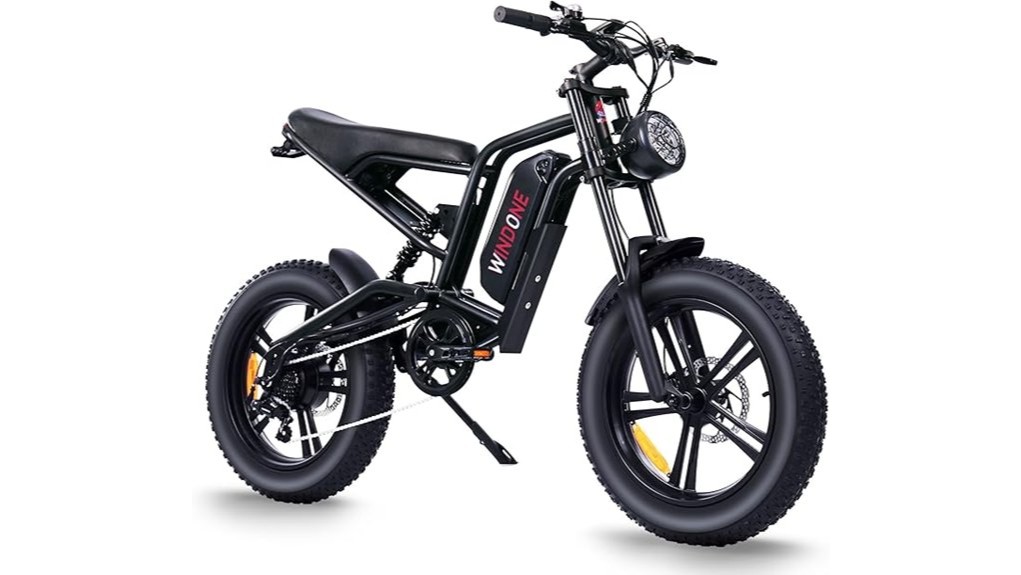
You’ll find the Windone E2 is a budget‑friendly Class 3 eBike that pairs a 1000W peak hub motor with full suspension and 20×4″ tires for confident urban commuting and light off‑road use. It hits about 28 MPH on pedal assist, climbs modest grades with rider input, and uses a removable 48V 13Ah UL2849 battery with IPX5 sealing and 6–7 hour charge time. It’s a solid value for riders wanting power and comfort; continue for detailed specs and tradeoffs.
Some Key Takeaways
- 1000W peak hub motor with Class 3 pedal assist delivers strong torque and up to ~28 MPH for brisk city and light‑offroad riding.
- 48V 13Ah (624Wh) removable, UL2849‑certified battery offers several dozen miles per charge and charges in about 6–7 hours.
- Full suspension (dual‑fork front and rear under‑suspension) plus 20×4.0″ fat tires provide cushioned, stable rides over varied terrain.
- Cadence sensing with four assist modes and pure electric limited to ~20 MPH gives smooth pedal feel and rapid acceleration control.
- Good budget value and high load capacity (330 lb), but limited IPX5 water protection and requires assembly upon delivery.
Windone E2 at a Glance : Verdict and Who It’s Best For
Although it borrows motorcycle-inspired styling, the Windone E2 delivers an electric-bike experience focused on power and versatility: its 1000W peak hub motor and Class 3 Pedal Assist (up to 28 MPH) give you strong acceleration and hill-climbing ability (up to 20% gradients), while a 48V 13Ah (624Wh) removable UL2849-certified battery balances range and reliability. You’ll find it suited for city commuting with urban styling that masks capable off-road readiness. For beginner riders it’s forgiving thanks to multiple ride modes and stable geometry. Compared to peers, it delivers notable budget value without sacrificing certified battery safety or practical daily utility. It’s a great fit for ebike riders who enjoy outdoor activities and need accessories and gear tailored to adult eBikes, especially those focused on outdoor rides.
Performance Deep Dive: Motor, Speed, Climbing, and Range
Having covered where the Windone E2 fits and who it suits, let’s examine what actually moves it: the powertrain and how that power translates to speed, climbing, and real-world range. You get a 1000W peak brushless hub motor delivering strong torque delivery for rapid acceleration and sustained cruising. In Pedal Assist it tops ~28 MPH; Pure Electric limits to ~20 MPH (Class 3 compliant). Cadence sensing aids proportional assist, smoothing pedal feel across four modes. Climbing is capable to ~20% gradients with rider input; range varies by mode, load, and terrain—expect several dozen miles per charge under mixed conditions. This bike is aimed at outdoor riders who want reliable performance for adventure and off-road use with a focus on ebike motors.
Battery, Charging, and Weather Durability Explained
Dig into the Windone E2’s power pack and you’ll find a 48V, 13Ah (624Wh) removable battery that balances capacity and portability for extended rides without excessive weight. You get UL2849 certification and IPX5 sealing—comparatively robust for commuter and light off‑road use—but IPX5 limits exposure to light rain, not immersion. Expect a 6–7 hour full charge from the supplied charger. For best battery longevity, adopt conservative charging etiquette: avoid full discharges, store at partial charge in cool conditions, and use the original charger. Compared to similarly spec’d bikes, the E2 trades maximal waterproofing for lighter, removable convenience. The site also offers products and advice to help riders keep batteries healthy for outdoor adventures.
Ride Comfort and Build: Suspension, Frame, Tires, and Fit
When you test the Windone E2, its ride comfort comes from a coordinated package: a front dual-fork absorber and rear under-suspension work together to smooth impacts, 20 x 4.0″ fat tires add low-pressure cushioning and traction on loose surfaces, and the 23 mm sponge saddle provides targeted cushioning for short-to-medium rides. You’ll notice the motorcycle-inspired metal frame balances stiffness and compliance, yielding stable handling compared with flexible cruiser frames. The fat tires plus suspension outperform rigid e-bikes on mixed terrain, improving saddle comfort and ride ergonomics. Fit range (170–198 cm) and 330 lb capacity suit most riders without compromising control. Riders who enjoy outdoor adventures will appreciate how fat ebike tires enhance traction and stability on trails.
Pros, Cons, and Buying Checklist : Should You Buy the Windone E2?
Although the Windone E2 pairs a stout 1000W peak hub motor and full suspension with fat 20 x 4.0″ tires to deliver strong hill-climbing and mixed-terrain capability, you should weigh its trade-offs—robust power, UL-certified removable 624Wh battery, and Class 3 top speed make it a compelling choice for performance-oriented riders, while IPX5 water resistance, six- to seven-hour charging, and required assembly may limit use and convenience for some. Pros: high torque, full suspension, removable UL2849 battery, 330 lb capacity. Cons: limited waterproofing, long charge, assembly required. Buying checklist: test-ride, verify warranty details, inspect build, assess resale value. Consider pairing the E2 with long-range batteries to boost your extended-range ebike adventures.
Some Questions Answered
Does the Bike Include Integrated Lights or Reflectors for Night Riding?
Yes — the bike includes integrated LED strips and reflectors placement for night riding. You’ll get LED strips likely mounted on the frame for low-profile visibility, while reflectors placement appears on the wheels and rear for passive detection. Compared to similar e-bikes, this combination offers active and passive visibility; however, you should verify brightness specs and consider adding stronger lights if you’ll ride frequently in very dark or high-traffic conditions.
Can the Battery Be Charged While Installed on the Bike?
Yes — you can perform battery charging while the battery is installed on the bike. Battery charging supports both onboard charging and removable-battery charging, though removable charging offers convenience and security. Technically, onboard charging uses the bike’s integrated port and original charger; removable charging lets you detach the 48V, 13Ah pack and charge separately. Compare both: onboard charging is simpler in-situ, removable charging is more flexible for indoor use and theft prevention.
Are Replacement Batteries or Parts Readily Available?
Yes — replacement batteries and parts are generally available, but availability varies. You’ll find OEM batteries through the manufacturer and third party batteries from aftermarket sellers; compare specs (48V, 13Ah, UL2849) and connector compatibility. Regional suppliers and authorized dealers stock common wear parts like tires, suspension components, and chargers. You’ll want to confirm warranty implications when using third party batteries and check shipping lead times from regional suppliers.
Is There a Warranty for the Motor and Electrical Components?
Yes — you get warranty coverage for the motor and electrical components. You’ll receive a manufacturer-backed limited warranty covering defects in motor, battery, controller, and wiring for a specified period; terms vary by region. Compare it to competitors: coverage is typical but may be shorter than premium brands. Service centers handle diagnostics, repairs, and part replacements; you’ll contact support to locate authorized centers and arrange warranty service and logistics.
Can the Bike Be Transported on a Standard Bike Rack?
Yes — you can transport it, but assess folding mechanism and rack compatibility first. The E2’s removable 48V battery and compact fold reduce bulk compared with full‑size fat‑tire e-bikes, improving fit on many trunk or hitch racks designed for 20″ wheels. However, its 20×4.0″ tires, full suspension and 330 lb capacity make it heavier and thicker, so you’ll need a heavy‑duty rack rated for e-bikes and wide tires for safe transport.