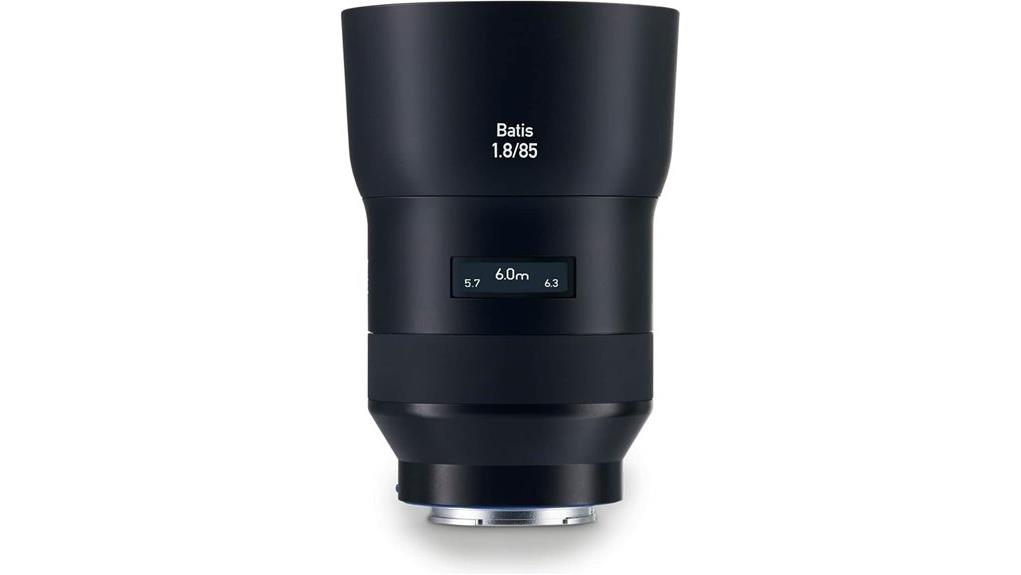
You’ll find the ZEISS Batis 85mm f/1.8 for Sony E a compact, weather‑sealed portrait prime that gives consistently high center sharpness, strong contrast, neutral-yet-vivid color, and reliable AF with a useful OLED distance readout. It handles well on mirrorless bodies, resists flare, and focuses smoothly with a tactile manual ring for fine pulls. If you want portable, pro-grade portrait performance and durable build without the weight of f/1.4 glass, this lens is worth a closer look.
Some Key Takeaways
- Excellent portrait optic: sharp center from f/1.8 with strong subject separation and high contrast rendering.
- Reliable autofocus: precise, quiet, and smooth with predictable eye/face detection performance.
- Solid build and weather sealing: metal construction, durable bayonet, and confidence for location work.
- OLED focus readout: instant distance and DOF feedback accelerates low-light workflows and focus pulls.
- Compact and portable: trades f/1.4 bokeh for lighter weight and all-weather reliability, ideal for wedding/portrait pros.
Verdict and Best Uses: Is the ZEISS Batis 85MM F/1.8 Worth It?
So, is the ZEISS Batis 85mm f/1.8 worth it? You’ll find its compact build, weather sealing, and reliable autofocus make it a practical pro-grade portrait tool. Use it for tight headshots, environmental portraits, and portrait storytelling where subject separation and handling matter. The OLED focus readout speeds workflows in low light, and metal construction supports heavy use on location. Color rendering and contrast support reduced postwork, preserving time. Price sits above some alternatives, but durable materials and Zeiss branding tend to protect resale value. If you prioritize consistent, professional results, this lens earns its place in your kit. It’s an excellent choice for photographers who favor prime lenses and want top-tier optical performance.
Optical Performance: Sharpness, Contrast, Color, and Flare Control
Having established its suitability for professional portrait work, let’s examine how the Batis 85mm performs optically: it delivers very high center sharpness from wide apertures and maintains impressive resolution across the frame by f/2.8–f/4, giving you clean subject isolation with little compromise when stopping down. You’ll appreciate sharpness consistency across apertures and the lens’ high contrast rendering that separates subject from background. Chromatic rendition is neutral yet vivid, producing accurate skin tones and saturated highlights without oversaturation. Flare control and internal coatings suppress ghosting in backlit scenes, preserving microcontrast so your images stay crisp in challenging light. For photographers who enjoy working with zoom and prime lenses alike, this performance makes it a strong choice for portrait work.
Autofocus and Handling: Speed, Accuracy, Focus Feel, and OLED Display
While you’ll notice the Batis 85mm doesn’t chase speed records, its autofocus is consistently precise and predictably smooth, making it ideal for portrait and event work where reliability matters more than outright velocity. You’ll get quiet AF operation that minimizes distraction and yields high hit rates on eyes and faces. The focusing mechanism shifts lens groups with controlled acceleration, so smooth focus shifts are easy to time for rack-focused shots. Manual override feels natural via the tactile ring, with firm, damped resistance for fine adjustments. The OLED readout gives instant distance and DOF feedback, useful in low light and quick setups. It’s a strong choice for photographers using third-party accessories like lens mount adapters to expand creative possibilities.
Build, Weather Sealing, and Ergonomics for Field Use
Crafted from robust metal alloys and sealed against the elements, the Batis 85 feels purpose-built for heavy field use and won’t shy away from rain-soaked shoots or dusty environments. You’ll appreciate the compact footprint that keeps pack space minimal while delivering a reassuring weight balance on mirrorless bodies. Seal testing by ZEISS is evident in confidence-inspiring operation; controls remain smooth after exposure. The grip texture on the manual focus ring gives predictable tactile feedback for quick adjustments and manual focus pull work. Mount durability is solid — the bayonet seats firmly, resisting wear under repetitive lens changes in the field. Consider pairing the lens with custom camera foam to protect it during transport and storage.
Who Should Buy This Lens and How It Compares to Alternatives
Who needs the Batis 85mm f/1.8? You do if you’re a portrait photographer or wedding photographer seeking a compact, rugged Sony E-mount prime that balances sharpness and handling. You’ll get excellent resolution, high contrast, and vivid color with minimized stray light for reliable results across apertures. Autofocus is smooth and accurate for fast-paced shoots; the OLED focus/readout aids low-light control. Compared with heavier f/1.4 alternatives, the Batis trades slightly shallower bokeh for better portability, weather sealing, and price-to-performance. If ultimate background blur or fastest aperture matters most, consider f/1.4 options; otherwise choose the Batis. This makes it a strong choice for photographers shopping for portrait lenses on sites like Perfect Portrait Lenses, where comparisons and lens-specific advice are available for Sony users and others looking to optimize their gear with trusted portrait optics recommendations.
Some Questions Answered
Does This Lens Come With Image Stabilization?
No — it doesn’t have optical stabilization in the lens. You’ll rely on your camera’s in-body sensor shift stabilization for steady handheld shots. The lens delivers excellent optics and fast, accurate AF, but stabilization is handled by the camera body. If you need stabilized results, use a Sony body with effective sensor shift or use a tripod. That combination gives the best practical performance for low-light and telephoto handheld work.
What Filter Thread Size Does the Lens Use?
The filter thread size is 67mm, so you can fit 67mm filters and replacement front caps easily. You’ll appreciate the compact, robust front cap that snaps on securely and protects the glass during transport. When using screw-on ND or polarizers, confirm they’re 67mm to avoid vignetting at wide apertures. The filter thread accepts common accessories, and paired with the lens’ weatherproof build, it maintains reliable protection and handling in the field.
Is a Lens Hood Included in the Box?
Yes — a lens hood is included. When you unbox the lens, the box contents list the lens, caps, pouch, and a petal-shaped lens hood that mounts securely for stray-light control and frontal protection. You’ll find the hood easy to attach and remove during shoots, offering effective flare suppression without vignetting at f/1.8. This addition supports outdoor and high-contrast usage, matching the lens’s rugged, weather-sealed build.
Can It Be Used on APS-C Sony E-Mount Bodies?
Yes — you can use it on APS-C Sony E-mount bodies, and it’ll behave as an ~127.5mm equivalent due to the 1.5x crop factor. You’ll get tighter framing suited to portrait photography with increased apparent reach, keeping the lens’s optical quality, autofocus performance, and OLED readouts. Expect slightly different depth-of-field characteristics and working distance versus full-frame; it remains a compact, high-resolution option for head-and-shoulders and short-telephoto use.
What Is the Minimum Focusing Distance?
The minimum focusing distance is 0.8 meters (2.6 feet). You’ll use that close range for close up portraits, retaining sharp subject detail while achieving pleasing shallow bokeh at f/1.8. Expect precise AF performance and a modest magnification useful for head-and-shoulders framing on full-frame (and tighter on APS-C). For tighter crops or extreme close-ups you’ll need extension or macro-specific optics; handhold carefully to maintain composition.