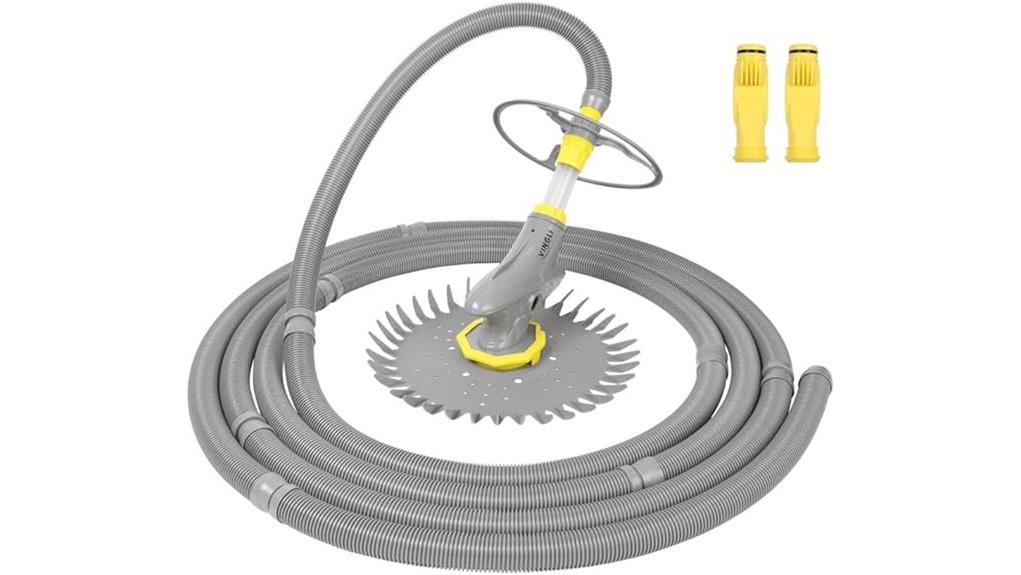
You’ll get a quiet, low‑maintenance suction‑side cleaner that’s built for reliable residential performance and simple upkeep. It uses a 36‑fin disc, long‑life diaphragm and FlowKeeper™ valve to hold continuous suction, maintain traction on tile or gunite, scrub walls to the waterline and handle steps with few hang‑ups. Installation’s straightforward and parts are accessible for seasonal care. Warranty and operating costs are moderate, and the review outlines limits, installation tips and alternative choices.
Some Key Takeaways
- Reliable suction-side cleaner with consistent traction and predictable coverage for small-to-medium debris on floors, walls, and steps.
- Simple, low-maintenance design: one-moving-part long-life diaphragm and Quick-Release Cassette for easy inspections.
- 36-fin disc and FlowKeeper™ Valve maintain seal and continuous suction, reducing hang-ups on tile, vinyl, and gunite.
- Easy shoe-string setup and wide pump compatibility, but verify hose seals, skimmer adapter seating, and valve settings.
- Moderate price with low operating noise and two-year defect coverage; consider alternatives for fine particulate or heavy debris.
What This Review Covers and Who the Zodiac G3 Is Best For
While this review evaluates the Zodiac G3 Suction-Side Inground Vacuum across performance, compatibility, design, maintenance, and value, it focuses primarily on how the cleaner performs in real-world residential settings. You’ll get concise analysis of suitability for common pool types, pump configurations, and routine maintenance tasks. The report highlights who should consider the G3: homeowner operators, beginner buyers seeking low-complexity installation, and those wanting quiet, low-maintenance suction cleaning. It notes practical considerations like seasonal storage, parts access, and two-year defect coverage. You’ll learn limitations and operational expectations to inform a practical purchasing decision.
How the G3 Cleans: Performance on Floors, Walls, and Steps
Because the G3 uses a 36-fin disc, long-life diaphragm, and FlowKeeper™ Valve together, it maintains continuous suction and close surface contact across floors, walls, and steps. You’ll notice consistent floor traction that prevents slipping on tile, vinyl, gunite, or fiberglass while the cleaner traverses contours. Wall scrubbing is effective up to the waterline; the disc and flow regulation keep the cleaner planted so the diaphragm cycles clear debris into the hose. Steps receive the same contact and suction pattern, with reduced hang-ups around fittings. Overall, you get predictable coverage for small-to-medium debris on multiple surfaces.
Design and Durability: Disc, Diaphragm, Hoses, and Maintenance
When you inspect the G3’s core components—36-fin disc, Long-Life diaphragm, and scuff-resistant hoses—you’ll see each part is engineered for sustained contact, reliable cycling, and low wear. You notice the 36-fin disc maintains traction and reduces hang-ups; its geometry provides consistent sealing against varied surfaces. The one-moving-part Long-Life diaphragm simplifies maintenance and limits failure modes, supporting silent, repeatable strokes. Scuff-resistant hoses resist abrasion and preserve finish; finishing touches like reinforced cuffs improve joint longevity. Material resilience comes from durable plastics and engineered elastomers. You’ll perform quick inspections and use the Quick-Release Cassette for efficient diaphragm access.
Setup, Compatibility, and Real-World Installation Tips
If you’re installing the Zodiac G3 in a typical residential inground pool, the shoe‑string setup—attach the disc and wheel deflector, snap the Quick‑Release Cassette into place, thread the 39‑ft push‑fit hose and connect to the skimmer or dedicated suction line—gets the cleaner running without tools. Verify pump compatibility (single-, two-, variable- or low‑flow) and set the FlowKeeper™ Valve. Use the quick connects guide to confirm hose seals and skimmer adapter seating. Route hose to minimize kinks and avoid suction fittings. For maintenance, rinse components, inspect the diaphragm, and follow seasonal storage: dry parts, coil hose loosely, protect from UV.
Value, Warranty, and When to Choose an Alternative
After completing setup and confirming pump compatibility, you’ll want to weigh the G3‘s upfront cost, warranty coverage, and long-term operating value against your pool’s needs. The G3 offers a moderate purchase price, low maintenance expense due to a single-moving-part diaphragm, and a 2-year limited warranty; perform a cost comparison against robotic and pressure-side units by factoring energy, filter load, and replacement parts. Choose the G3 if you need reliable suction-side cleaning, low noise, and simple servicing. Consider alternative recommendations—robotics for fine particulate and automation, pressure-side for heavy debris—when coverage, efficiency, or advanced features matter more.
Some Questions Answered
Can the G3 Pick up Large Debris Like Leaves and Twigs?
No — you shouldn’t expect it to reliably pick up large debris like branches; it handles small and medium debris best. In suction tests, large leaves and twigs can cause leaf clogs and reduce performance, requiring manual removal or pre-screening. You’ll avoid issues by using a skimmer basket or leaf net for oversized debris. Regular inspection and clearing of the hose and FlowKeeper™ valve keeps suction peak and prevents blockages.
Is a Dedicated Suction Line Required for Optimal Performance?
No — a dedicated suction line isn’t strictly required, but you’ll get better suction optimization with dedicated plumbing. Connecting to a dedicated line minimizes flow loss and interference from skimmer use, stabilizes pressure, and lets the FlowKeeper™ maintain peak performance. If you use a skimmer, verify low-flow or variable-speed pump compatibility and proper hose length. Install per instructions and test suction; adjust or add dedicated plumbing if coverage or debris pickup falters.
How Noisy Is the G3 During Operation?
You’ll find the G3 is relatively quiet; it produces minimal motor noise because it’s a suction-driven unit with no onboard motor. You’ll mostly hear water vibration transmitted through the hose and pump system rather than mechanical whine. Diaphragm-driven operation and scuff-resistant hoses reduce structure-borne noise. Expect occasional low-frequency thumps from debris ingestion; overall sound levels are comparable to typical suction-side cleaners and won’t dominate poolside conversation.
Are Replacement Parts Widely Available and Affordable?
Yes — replacement parts are generally available and affordable. You’ll find OEM and aftermarket options for diaphragms, discs, hoses, valves and cassettes through retailers and pool-supply channels. Aftermarket options lower cost but vary in fit and longevity; verify compatibility. Warranty coverage (2 years limited) may restrict claims if you install non‑OEM parts, so document purchases and prefer authorized dealers for warranty-sensitive components to avoid denied coverage.
Can the Cleaner Operate Continuously Without Overheating?
Yes — it won’t overheat during normal use. The cleaner relies on your pool pump for power and has no internal motor, so there’s no thermal shutdown within the unit itself. Continuous runtime is limited by pump duty cycle and plumbing setup; make sure your pump is rated for extended operation and monitor suction lines. Regular maintenance and proper FlowKeeper™ adjustment prevent strain that could trigger thermal shutdown in the pump.